Tag: history

  • Public Outcry Over Congressional Stock Trading

    Public Outcry Over Congressional Stock Trading

    By: seeker of truth

    Introduction:
    There is a growing wave of public criticism over U.S. lawmakers trading stocks while in office. Many Americans see it as a conflict of interest or even “legalized corruption,” and social media posts reflect intense anger at the idea that members of Congress can profit from inside knowledge. In response, several bipartisan efforts have emerged to ban or restrict congressional stock trading. Below, we analyze public sentiment on this issue, fact-check claims about specific lawmakers’ trades, examine whether partisan affiliation affects the criticism, and review current and proposed legislation (such as the TRUST in Congress Act and the Ban Congressional Stock Trading Act) aimed at addressing the problem.

    Public Sentiment on Lawmakers Trading Stocks

    On social media (e.g. X/Twitter), the sentiment is overwhelmingly critical of Congress members buying or selling stocks. Common themes include accusations of insider trading, conflict of interest, and demands for reform. Many posts argue that no lawmaker should be enriching themselves through stock trades obtained via privileged information. For example, one user wrote, “No member of Congress should be allowed to [be] trading stock while in office. Conflict of interest.”​. Others echo that Congress is “supposed to be a service, not a career,” implying that officials are in office to serve the public, not to get rich. The practice is often described as fundamentally corrupt: “They can use privileged information to make money on the stock market… Make no mistake, it’s legalized corruption. Banning the practice is long overdue.”​.

    Calls for reform or specific actions are frequent. Users across the political spectrum propose measures like outright banning members (and even their spouses or family) from trading stocks, enforcing blind trusts, and imposing term limits as a way to curb self-enrichment​. A representative post lists “3 easy steps to improve our government: 1) term limits on Congress, 2) ban lobbyists, 3) ban elected officials from trading stock”. There is also widespread support for pending reform bills (discussed later). Many commenters explicitly back legislative efforts to prohibit congressional stock trading. For instance, a user urges others to “call your congressperson in support of H.R. 396: TRUST in Congress Act, which would ban members of Congress from trading stock.” Another praises a lawmaker’s stance: “Members of Congress have access to all kinds of insider information – it’s common sense that we shouldn’t be able to play the stock market with it.”​. This quote, from Rep. Abigail Spanberger’s introduction of the TRUST in Congress Act, encapsulates the public’s common-sense view that lawmakers shouldn’t profit from non-public knowledge.

    Notably, praise for politicians who support a ban appears alongside the criticism. Posts commend figures like Rep. Alexandria Ocasio-Cortez and Sen. Josh Hawley for pushing to stop congressional trading. “Yes… I back AOC on this. No Congress person should be trading stock while in office. Or family members. Too close to the bone,” wrote a self-identified Democrat on X. Similarly, a conservative user agreed “Josh Hawley is 100% correct here. Congress should NOT be trading stock!”. Such cross-ideological agreement is striking – everyday commenters from left and right both cheer efforts to clamp down on lawmakers’ trades. In one instance, a user highlights that progressive Democrat AOC and pro-Trump Republican Matt Gaetz teamed up on a proposal to ban stock trading, lamenting that “of course it didn’t pass”. This bipartisan outrage from the public indicates a rare unity: Americans largely feel congressional stock trading is wrong and want it reined in.

    In summary, general public sentiment is that congressional stock trading is unethical and should be stopped. Posts are laced with anger at perceived double-standards (“Congress can do things that would land regular people in jail for insider trading”), and many stress that lawmakers’ duty to citizens should come before personal profit​. The tone of these discussions is often cynical and distrustful of Congress’s willingness to police itself: “Congress isn’t going to ban them trading stock. Most are greedy and there for monetary gains in spite of what they say.”​. This public pressure forms the backdrop for the current push to tighten the rules. Polls consistently show broad bipartisan support for banning lawmakers from trading individual stocks, reinforcing what these viral posts reflect – voters want stricter ethics so that elected officials cannot use their office for financial gain.

    Claims About Specific Members of Congress and Stock Trades

    Amid the furor, several members of Congress are frequently singled out in social media posts for alleged unethical stock trading. The names that recur include former House Speaker Nancy Pelosi, Rep. Dan Crenshaw, Rep. Marjorie Taylor Greene, Sen. Elizabeth Warren, and others. Often, these posts contain explosive claims – some accurate, some exaggerated. Here we examine a few prominent examples and compare them against factual disclosures and news reports:

    • Nancy Pelosi: Pelosi has become a central figure in the stock-trading debate. Numerous posts accuse her of personally profiting from insider information. One viral claim alleges “Nancy Pelosi made millions from insider-trading stock investments (big [money] from options)” during her tenure as House Speaker. It’s true that Pelosi’s family (notably her husband, Paul Pelosi) has actively traded stocks, including high-value options in tech companies, which has drawn public scrutiny. For example, Paul Pelosi at times bought large stakes in companies like NVIDIA and Google ahead of key votes or regulatory actions, creating an appearance of potential conflict​. In mid-2022, he purchased semiconductor stock just before Congress considered a major chips subsidy bill, prompting criticism and a quick sale of the shares to avoid the appearance of insider advantage​. However, no evidence of illegal insider trading by Pelosi has been proven, and she has never been charged with any such crime. In fact, one detailed analysis noted that while Pelosi’s portfolio “outperformed markets (700% vs. S&P’s 200% over a decade), no solid proof exists” of insider trading and “no charges [have been] filed” against her. This highlights the gap between public suspicion and what has been legally demonstrated. Pelosi herself long defended lawmakers’ right to trade. In December 2021, when asked about a possible ban, she argued “lawmakers should not be barred from trading stock” because “we are a free-market economy”. This stance was widely criticized since it acknowledged the practice “gives members of Congress the opportunity to profit off insider information gained through their official duties”. Facing backlash, Pelosi later softened her position and said she would be open to stricter rules. Indeed, under mounting pressure (and ahead of the 2022 elections), she allowed development of a reform bill, though it stalled. Bottom line: Pelosi’s high profile and sizable stock trades by her family have made her a symbol of the issue – her case illustrates how legal trades can still raise ethical questions. Public perception that she “enriched herself” in office aligns with the fact that her net worth grew substantially over the years, but any claim of “insider trading” remains unproven​.
    • Dan Crenshaw: Rep. Dan Crenshaw (R-TX) is another lawmaker often mentioned. Posts question whether “Dan Crenshaw [is] insider trading” and call him “a perfect example why we need to ban Congress from directly trading stock”. Crenshaw indeed has been an active stock trader. According to his financial disclosures, he and his wife made dozens of stock transactions, including in industries that intersect with his committee work (for instance, energy and defense companies). He also violated the STOCK Act’s reporting requirements at least once by disclosing trades past the 45-day deadline, for which he paid a fine (as did many colleagues). Critics point out that such late disclosures hide trades until well after the fact, defeating the purpose of transparency. While there’s no public evidence that Crenshaw traded on non-public information, the suspicion arises because some of his trades were well-timed with market movements. For example, observers noted he bought stock in companies that stood to benefit from legislation he was involved in. These patterns, even if coincidental or based on public info, feed the narrative that members “play” the market with an inside edge. Crenshaw has defended himself by saying he doesn’t personally manage his portfolio day-to-day. Nevertheless, he has faced enough heat that in 2022 he expressed openness to a ban, likely recognizing the optics. The public scrutiny of Crenshaw’s trades underscores a broader reality: dozens of lawmakers from both parties have similarly violated disclosure rules or seen their stock moves questioned. In 2021-2022, at least 55 members of Congress were found to have not properly reported trades on time as required by the STOCK Act, a fact that has intensified calls for reform.
    • Marjorie Taylor Greene (MTG): On the other side of the aisle, Rep. MTG (R-GA) has been called out in posts for frequent trading. “If you’re tired of members of Congress trading stock, talk to @RepMTG. She does this all the time,” one user quipped. Indeed, Greene, a first-term member, disclosed a high volume of stock transactions – over $3.5 million in trades during 2021, per her filings. She bought and sold shares in companies like Walmart, Boeing, and energy firms, even while loudly criticizing certain industries publicly. For instance, she invested in pharmaceutical and defense stocks around the same time she railed against vaccine mandates and foreign aid, respectively, prompting accusations of hypocrisy in the press. Like others, Greene has not been accused of anything illegal, but her case exemplifies why many find the practice problematic: even if lawmakers aren’t trading on secret info, the perception is that they could shape policy to benefit their portfolios. Greene’s trading activity, often more akin to a day trader’s than a public servant’s, is used by critics as a talking point that some in Congress treat their position as a money-making opportunity. She has responded to criticism by saying her trades are managed by a third-party advisor. Still, public posts label her “contemptible” for engaging in the very behavior she and her allies condemn in “elites”​.
    • Other Notable Examples: Posts also mention Senators from the 2020 COVID-19 stock sale scandal – specifically Richard Burr (R-NC) and Kelly Loeffler (R-GA). In early 2020, both sold large stock holdings right after attending a confidential Senate briefing on the looming pandemic, spurring DOJ investigations. Although neither was charged (prosecutors ultimately found insufficient evidence of insider trading), the incident looms large in public memory as a case of Congress members appearing to profit from disaster. It’s frequently cited in debates, reinforcing the feeling that “they knew and saved themselves while the public suffered.” Another current example making rounds online involves Rep. Michael McCaul (R-TX), who is chairman of the House Foreign Affairs Committee. A watchdog noted McCaul purchased over $1.1 million in Meta (Facebook) stock in spring 2023 “between March when he wrote the [TikTok ban] bill and April when he voted yes on” banning TikTok. This timing suggests he stood to gain if TikTok’s competitor (Meta) benefited from TikTok being restricted. Posts ask pointedly: “Do you think that’s a good look, Republicans? It is not.”. McCaul’s office claimed those investments were made by his wife’s trust, but to the public it looks like a textbook conflict of interest. Similarly, numerous members sitting on committees (from defense to healthcare) have traded stocks related to their oversight. A recent investigation found nearly 1 in 5 lawmakers (almost 100 members) or their immediate family made trades in companies that could be affected by their legislative work. This includes Democrats and Republicans alike – e.g. Sen. Tommy Tuberville (R-AL) repeatedly buying and selling biotech and tech stocks while overseeing military affairs, or former Sen. Dianne Feinstein (D-CA) whose husband traded defense contractor shares while she chaired the Intelligence Committee. None of these actions have led to charges, but they highlight how “members of Congress have access to information the average person would not know, and they should not be trading stock to enhance their pocketbooks,” as one social media user aptly put it​.

    Fact-checking these claims shows a pattern: public perception is often grounded in real behavior (extensive trading by lawmakers, pattern of potential conflicts), though direct proof of illegal insider trading is rare. In other words, many members are trading stocks and often in ways that raise eyebrows, but because of how current law is written and the difficulty of proving misuse of non-public information, almost none have faced legal consequences. The only recent member of Congress actually convicted of insider trading was Rep. Chris Collins (R-NY) in 2019 – and that was for tipping off his son about a biotech company’s private drug trial results (Collins sat on the company’s board). That case was unrelated to congressional duties, yet it shows members can abuse insider knowledge. For legislative matters, however, the STOCK Act of 2012 technically forbids using non-public government info for profit, but enforcement is essentially nonexistent. Instead, the Act’s main teeth are disclosure requirements, which as noted are frequently flouted with minimal penalties. The result is that no sitting member has been prosecuted under the STOCK Act for insider trading based on congressional knowledge. Public outrage does align with the reality that many lawmakers’ trading patterns would be considered dubious in any other context (e.g. an executive trading on pending corporate info), even if those lawmakers defend themselves as following the rules. The “insider” advantage may often be more about having a deep understanding of upcoming policy shifts rather than explicit confidential info, but the effect is similar – it erodes trust. As an anguished post summed up, “Anywhere else it would be called insider trading… We can’t trust Congress…other than [for] insider trading stock picks.”​.

    Partisan Differences in Criticism and Focus

    Is one party perceived as more culpable? Public sentiment transcends party lines in condemning congressional stock trading, but people tend to highlight the opposing party’s offenders more frequently. On social media, both Democrats and Republicans use the issue to score political points, even as they agree on the core problem.

    Many conservative-leaning commenters fixate on high-profile Democrats like Pelosi. For instance, posts with the hashtag #Pelosi call her a “criminal” who has been “trading stock [and] making millions for years”. They accuse her (and by extension other Democrats) of corruption, sometimes lumping it with broader conspiracy tropes (e.g. “CONgress… busy being pedos, trading stock, and getting kickbacks” in one extreme rant). The Nancy Pelosi narrative has been particularly prominent in right-wing circles – so much so that Sen. Josh Hawley cheekily named his 2023 stock-ban bill the “PELOSI Act” to underscore the point. Likewise, Republican or populist accounts often assert that “mostly Democrats” are guilty of profiteering​ – although in reality members of both parties trade. One tweet claimed “most Democrats don’t do it and most Republicans do”, reflecting a partisan perception that insider profiteering is a GOP motive for entering Congress. This is not supported by the data (Democrats trade just as much as Republicans), but it shows how each side’s base might view the other as the bigger problem.

    Conversely, left-leaning and liberal commentators emphasize Republican hypocrisy. Progressive posts frequently mention GOP figures who have opposed reforms or engaged in suspicious trades. For example, users have blasted Senate Republicans for blocking votes on stock trading bans, noting that every time Democrats introduce a bill, it gets stonewalled. A viral “context” explainer on X stated bluntly: “Democratic politicians have tried introducing legislation to block members of Congress from trading stock… GOP members of Congress have blocked every bill introduced.”. (This refers to the fact that in 2022, Republican leadership in the Senate did not advance a House proposal, and in the current Congress, GOP committee chairs have not moved forward on the Democratic-sponsored bills – a point of contention.) Liberal users also call out Republicans who trade. A pointed example is Rep. Mike McCaul’s Meta stock purchase during the TikTok ban effort, which a Democrat-aligned account highlighted to challenge the GOP: “Do you think that’s a good look Republicans?”. Another instance is Sen. Tommy Tuberville, a Republican often singled out in left circles for his prolific trading (and habitual late disclosures) – Democrats cite him as evidence that Republicans also exploit the system. In sum, left-leaning critics argue that while GOP lawmakers rail against “elitist corruption,” many partake in the same behavior and block reforms that would curb it​.

    Despite these different emphases, there is also a meeting of minds across party lines at the grassroots level. The anger at Congress’s self-dealing is one of those rare issues that unite populists on the left and right. Social media discussions sometimes acknowledge this unity. “The party doesn’t matter. No member of Congress should be trading stock,” one user wrote flatly​. Another user, responding to a partisan argument, conceded “It happens with both parties; you just focus on the one you don’t like.”​. This recognition that both Democrats and Republicans in Congress are guilty is reflected in calls to “check everybody” – “Let’s check everybody, including AOC, Pelosi, and so on,” as one tweet put it. There are also multiple posts praising bipartisan reform efforts: as noted, AOC and Gaetz’s collaboration received applause from across the spectrum, and Sen. Elizabeth Warren (a Democrat) and Sen. Hawley (a Republican) are both lauded by their respective followers for pushing similar bans. Interestingly, each side tends to trust its own champions on the issue (progressives trust Warren or AOC, conservatives trust Hawley or Gaetz), but they agree on the substance.

    In general, public perception of congressional stock trading doesn’t fall neatly along party lines – it’s more us (the people) vs. them (the politicians). Polls have shown that huge majorities of Republicans, Democrats, and independents alike support banning lawmakers from trading individual stocks. The difference by political affiliation mainly lies in who gets spotlighted as the worst offenders or as the blockers of reform. For Republicans online, Pelosi and other Democratic leaders are the favored targets (“Pelosi & top Dems’ wealth… insider trading… 700% gains” as one claim went​). For Democrats online, the issue is often framed as Republicans cynically opposing a ban to protect their own investments (noting, for instance, that many in the GOP voted against a 2022 ban proposal). Both narratives contain grains of truth: Pelosi was initially opposed to a ban and is indeed very wealthy, and Republican leadership has not embraced the reform bills. But importantly, members of both parties have traded scandalously, and members of both parties have authored bills to end it. As one frustrated observer tweeted, “This should include all GOP and Dem members – it’s an obvious conflict of interest… It needs to END, right now, forever.”​. That sentiment captures how many Americans see the matter: not as a partisan issue, but a systemic ethical failure that transcends party.

    Legislative Efforts to Curb Congressional Trading

    The public outcry has spurred a flurry of legislative proposals aimed at restricting or banning stock trading by members of Congress (and sometimes their spouses and staff). Currently, the law in force is the STOCK Act of 2012, which requires members to disclose trades over $1,000 within 30-45 days and explicitly affirmed that insider trading laws apply to Congress. While the STOCK Act increased transparency, its weak enforcement and loopholes (members can still own and trade stocks freely as long as they report later) have led to widespread agreement that it’s insufficient. In the past few years, especially since 2021, there’s been a bipartisan push to strengthen the rules. Below is an overview of major proposed legislation on this issue and their status:

    • TRUST in Congress Act (House and Senate bills): The Transparent Representation Upholding Service and Trust in Congress Act – often shortened to TRUST in Congress Act – is among the most prominent proposals. Originally introduced in 2020 and reintroduced in subsequent sessions by Rep. Abigail Spanberger (D-VA) and Rep. Chip Roy (R-TX), this bipartisan bill would ban members of Congress (and their spouses) from trading individual stocks while in office. Instead, lawmakers would have to either divest their holdings or place them in a qualified blind trust managed independently​. The idea is to remove even the temptation or appearance of using insider knowledge. Spanberger has been a vocal advocate, arguing it’s “common sense” to bar stock trading given the information lawmakers are privy to. Dozens of co-sponsors from both parties have signed on. In the current 118th Congress (2023-2024), Spanberger’s House version was filed as H.R. 265 (earlier referenced as H.R. 336 or H.R. 1679 in drafts)​, and a Senate companion was introduced by Sen. Kirsten Gillibrand (D-NY) and Sen. Josh Hawley (R-MO), showing cross-party support. Despite bipartisan backing, the bill has not yet received a floor vote. Advocates were disappointed in late 2022 when a similar proposal was tabled instead of passed. The TRUST in Congress Act remains a key rallying point – supporters frequently urge constituents to pressure Congress to pass it. As of 2025, the Act has not become law, but momentum is still building. The new House Speaker has indicated openness to considering a stock trading ban, suggesting the TRUST Act or something like it could be revisited.
    • Ban Congressional Stock Trading Act: Another major proposal comes from the Senate side. In early 2022, Sen. Jon Ossoff (D-GA) and Sen. Mark Kelly (D-AZ) introduced legislation informally known as the Ban Congressional Stock Trading Act. This bill is quite similar to the TRUST Act in that it would require members of Congress, their spouses, and dependent children to either divest from individual stocks or place assets in a blind trust during their tenure. Violations would carry fines (for example, lawmakers would forfeit any profits to the U.S. Treasury). Ossoff, a freshman senator who notably put his own investments in a blind trust upon taking office, wanted to ensure all members do the same to “remove corruption or the perception of it.” The proposal gained several co-sponsors, including at least one Republican. In the 118th Congress, one version of this concept was introduced as S. 3494 (a previous session’s number) and likely reintroduced with a new number (possibly the S.2773 mentioned in tweets)​. While this specific bill did not advance to a vote in 2022, it added pressure on congressional leaders. Notably, then-House Speaker Pelosi’s reversal to consider a ban was in part a response to multiple bills like Ossoff’s gaining public support. A revised framework combining elements of these proposals was drafted in late 2022 by House leaders, but it stalled due to disagreements on details (such as whether to include spouses, Supreme Court justices, etc.). In 2023 and 2024, lawmakers have continued to file versions of the ban. The diversity of bills (TRUST Act, Ossoff/Kelly’s bill, etc.) shows a broad agreement on principle but differences in specifics, which has somewhat fragmented the effort.
    • PELOSI Act: In January 2023, Sen. Josh Hawley (R-MO) introduced a bill with a cheeky acronym: the Preventing Elected Leaders from Owning Securities and Investments (PELOSI) Act. Hawley, a conservative populist, used Pelosi’s name to underscore the bipartisan nature of the problem (even though Pelosi herself was no longer Speaker by 2023). The PELOSI Act would ban members of Congress and their spouses from holding or trading individual stocks during their tenure, with a grace period upon taking office to divest or put assets in blind trust. If they violate, the law would require the Government Accountability Office to seize the lawmakers’ stock profits. Hawley’s proposal aligns closely with the others — its main distinction was rhetorical branding. It reflects growing Republican support for a ban; a few years prior, such proposals came mostly from Democrats, but by 2023 figures like Hawley were leading the charge on the right. The bill was introduced in the Senate (likely corresponding to S. ?2773 referenced in social media) and drew some attention in conservative media. However, like the others, it has not yet advanced beyond committee.
    • Other Bills (ETHICS Act, TRUST, etc.): In addition to the above, there have been numerous related bills, often with acronym names:
      • The ETHICS Act (“Ending Trading and Holdings in Congressional Stocks Act”) was another bipartisan Senate bill (co-sponsored by Sen. Jeff Merkley (D-OR) and Sen. Sherrod Brown (D-OH), among others) aiming to prohibit members of Congress from trading stocks and mandate divestment or blind trusts. The ETHICS Act has been put forward in various forms since 2021.
      • The DIVEST Act is yet another proposal along these lines (details on this one were less publicized, but based on the name, it likely required complete divestiture of conflicting assets by officials).
      • There’s also the Ban Conflicted Trading Act, originally introduced by Sen. Merkley and Rep. Raja Krishnamoorthi (D-IL) in 2020, which would bar members and senior staff from trading stocks while in office.
      Each of these bills shares the same fundamental goal – removing the temptation for lawmakers to play the stock market for personal gain – but they vary in scope. Some extend the ban to spouses and family (to close the “spouse loophole” often mentioned, since, for example, Paul Pelosi is not a member but his trades benefit the household). Others include senior congressional staff or judges in the ban. There’s debate over how broad to cast the net.

    Current status (as of 2025): None of these proposals has become law yet. In 2022, there was a swell of momentum: a compromise bill that combined elements (covering members of Congress, spouses, and even federal judges) was drafted in the House. However, it was introduced very late and never got a vote, reportedly due to mixed support and the clock running out in the session​. With the new Congress in 2023, reformers immediately reintroduced their bills. Lawmakers like Spanberger, Roy, Ossoff, Hawley, Warren, and others have continued to champion the cause. The House Administration Committee held hearings on the issue, indicating serious consideration. Public pressure remains high, and even President Biden has signaled support for a ban (at least according to some reports – one viral tweet claimed Biden, in a “farewell address,” called for banning congressional stock trading​, reflecting the expectation that the White House would sign such a reform if sent to his desk).

    It’s worth noting that some resistance persists within Congress, across party lines. Lawmakers who oppose a ban argue that requiring divestment could deter people from public service or that a blind trust is an excessive step. There are also nuanced questions being debated: Should the ban also cover commodities, cryptocurrencies, or just stocks? What about mutual funds or index funds (most proposals allow diversified funds as a permitted investment to avoid lawmakers having to sit entirely out of the market)? Should it apply to the executive branch and judiciary for consistency? These details are being hashed out. For example, the TRUST in Congress Act focuses on Congress members and spouses. The House’s late-2022 draft expanded to judges and top officials. The MEME Act (mentioned humorously in one tweet​\) targeted a very niche issue (banning officials from promoting cryptocurrencies) showing how the conversation even extends to newer asset classes like crypto and NFTs. All this indicates that while there is agreement in principle, the challenge is crafting a bill with enough consensus to pass.

    Nonetheless, the drive for reform has not died. With public opinion so strongly in favor (surveys have shown 70–80% of Americans support a ban), it is likely only a matter of time before some form of these proposals is enacted. Congressional leaders in both parties have faced pressure to act. For instance, in 2023, new House Speaker Kevin McCarthy expressed openness to a stock ban rule, and several rank-and-file members ran campaigns partly on this issue. In the Senate, Majority Leader Chuck Schumer said he told members, “I am sympathetic to this reform and asked committees to look at it.” The continued stream of negative headlines – e.g. each time a shady-looking trade by a lawmaker comes to light – adds urgency. As one commentator wryly observed, “Prohibiting members of Congress from trading stock is a total no-brainer — and long overdue.”​ The fact that so many bills with catchy acronyms are in play shows lawmakers know the public is watching.

    In summary, current U.S. law (the STOCK Act) stops short of banning stock trades by Congress, but a broad coalition of reformers is pushing to change that. The TRUST in Congress Act and the Ban Congressional Stock Trading Act are leading examples, with provisions for blind trusts that would effectively eliminate the most glaring conflicts of interest. Other proposals like Hawley’s PELOSI Act underscore that this is not a partisan issue in terms of support – members from both sides have authored similar reforms. The main obstacle has been getting leadership to prioritize the issue and unify around one approach. As of early 2025, the effort is very much alive: hearings have been held, bills are pending, and public clamor is only growing louder.

    Alignment of Public Perception with Reality

    It’s clear that public perception and anger about congressional stock trading stem from real patterns of behavior. Lawmakers from both parties have indeed taken actions that look like profiteering from their positions – whether or not they technically broke the law. The perception is that Congress has been unwilling to police itself, and unfortunately this is largely true so far. Many posts online accuse Congress of being greedy or corrupt for allowing members to trade, and this aligns with the reality that numerous lawmakers have been caught in conflicts or violated the spirit of ethics rules​. Public distrust is further validated by the fact that enforcement of the STOCK Act has been lax (only small fines for late reporting, no prosecutions for trading on inside info in congressional context). In short, people feel the system is rigged to benefit insiders – and the existing rules have not been enough to prove them wrong.

    However, it’s also true that not every claim on social media is fully accurate. Some assertions, like “Pelosi made $100 million from insider trading” or “only Democrats are doing this” or conversely “only Republicans are blocking it,” are exaggerated or overly partisan. The actual trading behavior cuts across party lines, and figures like Pelosi become lightning rods partly due to their prominence. When fact-checked, we see that Pelosi’s trades were real but there’s no hard evidence she violated insider trading laws, and that Republicans as well as Democrats have stalled reform at different times (e.g. Democratic leadership also delayed action when they had the majority in 2022, even if Republicans were the most vocal skeptics). Public perception sometimes oversimplifies these nuances. Yet, on the core issue – that Congress members trading stocks is a conflict of interest – public sentiment is justified by the facts. Even lawmakers themselves, when candid, have acknowledged the problem. “Members of Congress have access to information … it’s common sense we shouldn’t be playing the stock market,” as Spanberger said. Or in Sen. Hawley’s words, “Members of Congress should not be trading stock, they shouldn’t be.”There is very little counterargument being offered in good faith, except the notion that perhaps strict rules might be inconvenient for some lawmakers’ finances – a position that holds little water with the public.

    As of now, public pressure is mounting on Congress to align its rules with basic ethics that other professions follow. Corporate executives, for instance, face blackout periods and insider trading laws with real teeth; many Americans wonder why members of Congress – who arguably have more wide-ranging insider knowledge – are given so much leeway. The calls to ban congressional trading are essentially asking Congress to hold itself to a higher standard to restore trust. It is a rare issue enjoying support from progressive reformers, populist conservatives, and good-government moderates alike. The controversy won’t subside until either a strong law is passed or, alternatively, Congress convincingly self-polices (which so far it has not). Given the trajectory, most observers expect some reform to eventually be enacted, if only because lawmakers up for reelection feel the heat from constituents on this topic.

    In conclusion, the public sentiment as captured in the X posts is one of impatience and moral clarity – people see congressional stock trading as wrong, full stop. That perception matches the reality that current laws have failed to prevent even the appearance of self-dealing. While not every allegation is proven, the overall distrust is well-earned by years of permissive rules and examples of dubious trades. The ongoing debate and proposed legislation like the TRUST in Congress Act and the Ban Congressional Stock Trading Act are attempts to bridge the gap between public expectation and Congressional practice. If and when such a ban is implemented, it would mark a significant step in ethics reform – one that the public has been loudly demanding and that would finally ensure lawmakers “live by the same rules” they impose on others, restoring a measure of integrity to Congress’s reputation.

  • Due Process in Immigration Enforcement: Rights, Risks, and Precedents

    Due Process in Immigration Enforcement: Rights, Risks, and Precedents

    by: seeker of truth

    Due Process Rights of Non-Citizens under U.S. Law

    The U.S. Constitution guarantees due process of law to all “persons” within the United States, not only to citizens. The Fifth Amendment (binding the federal government) and the Fourteenth Amendment (binding the states) both use the term “person,” which courts have long interpreted to include citizens and non-citizens alike. In fact, the Supreme Court has explicitly affirmed that “aliens, even aliens whose presence in this country is unlawful, have long been recognized as ‘persons’ guaranteed due process of law by the Fifth and Fourteenth Amendments.”​ Similarly, once a non-citizen is physically on U.S. soil (even if unlawfully), “the Due Process Clause applies to all ‘persons’ within the United States, including aliens” regardless of legal status​. In short, non-citizens inside the U.S. have a constitutional right to due process of law.

    In practical terms, due process for non-citizens means that immigration enforcement and deportation decisions must follow fair procedures. The Supreme Court has stated that “it is well established that the Fifth Amendment entitles aliens to due process of law in deportation proceedings.”

    This entails at minimum the right to a fair hearing before an impartial adjudicator, the right to present evidence, and the right to challenge the government’s evidence before being expelled from the country. Most individuals facing removal are entitled to a proceeding in immigration court where a judge decides if the law permits their deportation or grants relief. As the International Rescue Committee notes, due process requires just and fair treatment of everyone, regardless of status, whenever life, liberty, or property is at stake – including the opportunity to defend their rights in court​. In the immigration context, this typically means having a chance to go before a judge to contest removal; indeed, “non-citizens facing deportation have a right to due process, which usually includes a hearing before a judge.”

    However, how these rights play out can be complex, and immigration proceedings do not always mirror the full procedural protections of criminal trials. Immigration law is civil, not criminal, so certain rights (like government-appointed counsel) do not automatically apply. Non-citizens have the right to legal counsel in deportation proceedings, but at their own expense, as courts have not recognized a right to free appointed counsel in immigration cases​. This lack of appointed counsel is significant because immigration law is complex and many immigrants speak limited English; one study found that having a lawyer makes an immigrant five times more likely to win the case than an unrepresented person​. Additionally, immigration courts allow evidence that would be excluded in criminal courts (such as hearsay),and many immigrants in detention proceed without representation, raising concerns about the robustness of their due process protections.

    There are also statutory shortcuts in the immigration system that limit due process, such as expedited removal. Under laws first enacted in 1996, certain undocumented immigrants who are caught near the border or who recently entered can be deported quickly without seeing a judge​. In expedited removal, a single immigration officer can order removal unless the person expresses an intent to seek asylum or fear of persecution​. As a safeguard, asylum seekers subjected to expedited removal must be given a “credible fear” interview with an asylum officer and an opportunity for review by an immigration judge if they fail the screening​. But beyond that limited process, there is no routine court hearing for others in expedited removal​. This procedure has been criticized for its minimal process. Even so, the government defends it as legal, arguing (as a White House spokesperson did) that “just because you don’t see a judge doesn’t mean you aren’t receiving due process.”​ In essence, the legal baseline is that all non-citizens on U.S. soil have due process rights, but Congress and the executive have some leeway in structuring immigration procedures, as long as basic fairness is maintained. When truncated processes like expedited removal are used, they are often challenged as denying “full” due process, especially if they result in erroneous removals.

    It’s important to note that even undocumented immigrants and asylum seekers have constitutional protections – although those who have never entered U.S. territory (for example, people stopped at airports or outside the border) are accorded more limited rights. Courts have drawn a distinction between non-citizens who have effected an entry into the U.S. (even if unlawfully) and those who are held at the border or in transit. Non-citizens “within the United States” are protected by due process,​ but someone seeking initial entry may only have whatever procedural rights Congress provides by statute. In recent cases, the Supreme Court has upheld some limits on court review of expedited removal for recent entrants, indicating that Congress can deny full judicial review in that narrow context (as in the 2020 case DHS v. Thuraissigiam, which found that an asylum seeker who was caught right after crossing had no constitutional right to a full habeas corpus hearing on his asylum claim). Nevertheless, once individuals are inside the country and living under U.S. jurisdiction, they are entitled to fundamental due process protections in any proceeding that could deprive them of liberty.

    In summary, U.S. law recognizes that non-citizens have due process rights. Undocumented immigrants and asylum seekers have the right to fair proceedings and cannot be arbitrarily detained or deported without some legal process. The exact procedures can differ from criminal trials, and expedited methods exist, but the Constitution’s guarantee that no “person” shall be deprived of liberty without due process applies to all individuals on American soil​.

    As the ACLU of Kentucky emphasizes, the fundamental protections of due process and equal protection are “not limited to citizens,” and the Framers understood the importance of shielding non-citizens from governmental abuse.​

    Documented Instances of Denial of Due Process in Immigration

    Despite these legal protections on paper, there have been numerous instances where individuals were detained, deported, or otherwise denied legal protections without full due process. These examples highlight how deviations from due process can lead to serious injustices:

    • Wrongful Deportation of U.S. Citizens: Perhaps the most stark examples are cases of American citizens being mistakenly detained or deported by immigration authorities. By law, U.S. citizens should never be subject to deportation, yet immigration enforcement errors have occurred. For instance, Mark Lyttle, a North Carolina-born U.S. citizen with mental disabilities, was wrongfully detained by ICE and deported to Mexico in 2008 despite “ample evidence” of his U.S. citizenship​. Lyttle spoke no Spanish and had no ties to Mexico, but because of his disability and a breakdown in procedures, he was coerced into signing a statement conceding to being Mexican and was removed without access to a lawyer. He spent months wandering homeless in Central America until a U.S. embassy official helped him return; it took a lawsuit for this grievous mistake to be acknowledged. Tragically, Lyttle’s case is not isolated. A 2021 Government Accountability Office (GAO) report found that ICE may have unlawfully deported as many as 70 U.S. citizens from 2015 to 2020​. In that period, ICE agents “arrested 674 potential U.S. citizens, detained 121, and deported 70” of them before the errors were discovered​. These mistakes occurred in part due to inadequate procedures and database errors, and they underscore that when due process is rushed or absent, even citizens can be swept up and permanently expelled. Such cases vividly illustrate the claim that denying due process to some endangers everyone – if a U.S. citizen can be deported without a fair hearing, anyone’s rights can be called into question.
    • Mass Deportations Without Hearings (Expulsions under Wartime Pretexts): In extraordinary situations, authorities have bypassed normal legal processes entirely. A recent example took place in March 2025, when the administration of President Trump (following his reelection) orchestrated a mass expulsion of nearly 300 immigrants to a foreign prison without standard legal proceedings. Under the pretext of invoking the 1798 Alien Enemies Act – a rarely used wartime law – officials rounded up Venezuelan and Salvadoran nationals in the U.S., accused them of gang affiliations without court adjudications, and put them on planes to El Salvador. Over **130 of the Venezuelans had pending immigration court cases and had never been ordered removed by a judge, yet they were suddenly deported en masse. None of these individuals were given any opportunity to challenge their removal in court or plead their case – according to reports, they “were not told what was happening nor given any opportunity to raise objections in a court of law” before being sent away​. They effectively had zero due process. Once in El Salvador, they were imprisoned in harsh conditions, and as of the report their fate remained unknown​. This incident, now under legal challenge​, demonstrates how easily normal legal safeguards can be cast aside. It is a dramatic illustration of due process being denied wholesale to a group, and civil liberties groups argue it was an “unprecedented and unlawful” abuse of power​. The fact that a law used to justify World War II internments was repurposed to deport people in peacetime, without hearings, underscores the dangers of loosening due process constraints.
    • Detention Without Hearings or Access to Attorneys: There have also been patterns of immigrants being held in prolonged detention without adequate procedural safeguards. In the wake of the September 11, 2001 attacks, for example, hundreds of non-citizens (mostly Muslim or Middle Eastern men) were arrested and detained for months without charges or proper hearings under a sweeping dragnet, ostensibly for minor immigration violations while authorities investigated them for terrorism ties. Many of those individuals were cleared of any wrongdoing but only after enduring lengthy detention with limited access to counsel and secret hearings, a process the Department of Justice’s own Inspector General later criticized as violating basic due process. Another systemic issue is the lack of appointed counsel: studies in immigration detention centers (for instance, in California) have found that the majority of detainees go through deportation proceedings without legal representation, which advocates say results in people being deported without a meaningful chance to present a defense​. Especially vulnerable populations – such as asylum seekers, children, or people with mental disabilities – may be effectively denied due process if they cannot understand the legal proceedings. In fact, the ACLU has filed class action suits on behalf of detained immigrants with mental disabilities who were unable to represent themselves; in one such case, a federal judge noted that holding these individuals without providing counsel was tantamount to denying them due process, leading to court-ordered reforms. These instances show that even when the law formally affords due process, in practice people can be denied meaningful due process through lack of information, lack of legal help, or rushed and inaccessible proceedings.
    • Historical Examples – Japanese American Internment: History provides a sobering example in the World War II internment of Japanese Americans. In 1942, about 120,000 people of Japanese ancestry on the West Coast – the majority of them U.S. citizens – were forcibly removed from their homes and incarcerated in camps without trial or individual review. This mass deprivation of liberty was done by executive order and upheld by the Supreme Court at the time (Korematsu v. United States, 1944), even though those affected were not accorded any hearings or due process to contest their loyalty. Decades later, this policy is widely recognized as a grave injustice and a denial of constitutional rights. It stands as a cautionary tale of how easily the rights of a minority group can be suspended, and how courts and the public may later regret such actions. The Korematsu case was formally repudiated by the Supreme Court in 2018, but its legacy fuels vigilance against repeating similar due process violations. Justice Robert Jackson’s famous dissent in Korematsu warned that approving such a racial exclusion “lies about like a loaded weapon, ready for the hand of any authority that can bring forward a plausible claim of an urgent need”​. In other words, once a precedent is set that a certain group can be stripped of due process, that power can be used again in the future against others.

    Each of these examples reinforces the idea that when legal protections are shortcut or ignored for some people, mistakes and abuses occur. Innocent people (including citizens) have been caught up in enforcement due to inadequate process, and disfavored groups have been targeted for harsh measures outside the normal judicial system. These real-life cases illustrate the concrete meaning of denying due process – prolonged detentions without hearing, deportations without a day in court, and entire groups being deprived of liberty based on blanket executive fiat. They also set the stage for why many jurists and advocates insist that upholding due process for non-citizens is essential to safeguarding everyone’s rights.

    Warnings about Eroding Due Process for Some Groups

    Legal experts, judges, and civil liberties organizations have frequently warned that if due process protections are eroded for one group, it creates a dangerous precedent that can erode the rights of all. This idea – that the denial of due process to anyone threatens everyone – is supported by historical experience and legal reasoning. A number of authoritative voices have articulated this warning:

    • Civil Liberties Organizations: The American Civil Liberties Union (ACLU) has long emphasized that protecting the rights of “the most unpopular groups” is necessary if we want to preserve those rights for society as a whole. In a historical reflection, the ACLU noted its famous defense of a Nazi group’s free speech in the 1970s, explaining it as a commitment to the principle that constitutional rights must apply even to those we despise, otherwise those rights won’t endure for anyone. This principle applies equally to due process: the ACLU of Kentucky, for example, states plainly that “[w]hen the government has the power to deny legal rights and due process to one vulnerable group, everyone’s rights are at risk.”​ Non-citizens are often a vulnerable or politically unpopular group, and the ACLU warns that if we permit government agencies to bypass the Constitution in dealing with immigrants, that “power to deny legal rights” can expand to affect citizens as well​. In advocacy against certain immigration policies, civil rights groups argue that measures like indefinite detention without trial, expedited removal without hearing, or suspension of habeas corpus for certain categories can quickly metastasize. Today it might be “terror suspects” or “illegal immigrants,” but tomorrow it could be protesters, dissidents, or other marginalized citizens labeled as threats.
    • Jurists and Judges: Members of the judiciary have also cautioned against creating carve-outs to due process. A vivid example is Justice Robert Jackson’s dissent in Korematsu (1944), mentioned above, where he warned that legitimizing the denial of rights based on ancestry would become a “loaded weapon” for future authorities to use in other contexts. His prediction proved prescient; although Korematsu was specific to wartime internment, its underlying logic (deference to executive claims of security over individual rights) could have been used to justify other mass deprivations. More recently, in the context of the War on Terror, Justice Sandra Day O’Connor wrote in Hamdi v. Rumsfeld (2004) (a case about a U.S. citizen detained as an “enemy combatant”) that a state of war is not a “blank check” for the President when it comes to the rights of citizens. This sentiment pushed back on the idea that certain individuals could be denied basic due process (like a fair hearing to contest their detention) even in the name of national security. Lower court judges have similarly sounded alarms. For instance, when the Supreme Court in 2020 (DHS v. Thuraissigiam) upheld limits on judicial review for an asylum seeker’s expedited removal, the dissenting justices argued that the decision undermined a cornerstone principle that even those on the margins are entitled to petition courts for relief. Justice Sotomayor’s dissent lamented that the ruling risked “leaving [individuals] without recourse to any judicial forum” and cautioned against “handing the keys to the Liberty Kingdom” entirely over to the political branches for certain groups – a scenario that could erode liberty for all in the long run (paraphrasing her argument).
    • Legal Scholars and Commentators: Constitutional scholars often emphasize the slippery slope that comes with carving out exceptions to due process. The rule of law, they argue, functions only if it applies evenly. As one commentator put it, due process isn’t just about protecting the accused individual – it also gives the public confidence that the government can’t arbitrarily detain or punish someone. If we begin cheering the denial of due process for people we dislike (say, undocumented immigrants or those accused of terrorism), we set a precedent that weakens the universal shield of the law. This perspective is summed up by the maxim that “the Constitution isn’t a privilege for citizens only.” Indeed, Charles Kuck, a past president of the American Immigration Lawyers Association, remarked in response to attempts to strip immigration detainees of legal protections: “When a government begins to argue that due process and basic constitutional protections do NOT apply to a portion of the population living in the United States, … it could easily be extended to another portion of the populace.”​ In other words, once we accept that some people on U.S. soil have no right to a fair hearing or other constitutional safeguards, we open the door to the government applying the same logic to others. This warning was issued when certain 2000s-era policies attempted to deny effective counsel to immigrants; legal experts saw it as a harbinger of broader erosions if not corrected​.
    • National Security Context: After 9/11, many experts warned that policies like the PATRIOT Act and detentions in Guantánamo Bay would set dangerous precedents. For example, when the government claimed the power to hold even U.S. citizens as enemy combatants without charges, scholars noted that this was a radical departure from due process. Organizations ranging from the ACLU to the Cato Institute cautioned that sacrificing due process in the name of security would normalize government overreach. The ACLU’s history highlights its opposition to “the indefinite detention of terrorism suspects without charge or trial”, arguing that such practices “expand the government’s power to … imprison people without due process” and thus threaten fundamental freedoms. The underlying concern is that once the public accepts that certain people can be locked up with no trial (whether they are non-citizens abroad or even citizens deemed enemies), the basic restraint on government power – the requirement of due process – is weakened for everyone. This concern materialized in debates over the NDAA of 2012, where a provision was criticized for potentially allowing military detention of American citizens on U.S. soil without trial if accused of terrorism. A bipartisan array of civil libertarians sounded alarms that such authority, once in law, could be misused in the future against political dissidents or others, far from the original context of Al Qaeda.

    In sum, there is a broad consensus among civil liberties advocates and many jurists that eroding due process for any group of people sets a precedent that endangers all people’s rights. Today’s denial of due process to immigrants at the border, or to detainees at Guantánamo, can become tomorrow’s justification for denying due process to citizens in some domestic context. This is why court rulings often take the long view: for instance, when the Supreme Court in Boumediene v. Bush (2008) granted Guantánamo detainees (non-citizens) the right to file habeas corpus petitions, it was not out of sympathy for enemy fighters but out of recognition that denying judicial review entirely would gut a fundamental check on executive power. Justice Kennedy wrote that the laws and Constitution are designed to endure and protect liberty in both good and bad times; hence the judiciary must ensure that fundamental rights like habeas (and by extension due process) are not arbitrarily suspended for a subset of individuals. The common thread in these warnings is clear: a government that can dispense with due process for some can eventually dispense with it for anyone, unless firmly restrained by the Constitution and courts.

    Constitutional and Legal Arguments for Universal Due Process

    The claim that “due process must apply universally to protect everyone” is grounded in bedrock constitutional principles and has been supported by numerous legal arguments. Key points supporting this claim include:

    • Text of the Constitution: Both the Fifth Amendment (“No person shall be … deprived of life, liberty, or property, without due process of law”) and the Fourteenth Amendment (“nor shall any State deprive any person of life, liberty, or property, without due process of law”) explicitly extend due process protections to “persons” – not just to “citizens.” The choice of wording was intentional. The framers of the post-Civil War amendments, in particular, ensured that basic rights would cover every person within U.S. jurisdiction​. This universality in text is a strong argument that due process is a general guarantee: the law must treat anyone subject to a deprivation fairly, whether or not they are a citizen. The Equal Protection Clause likewise protects any “person” within a state’s jurisdiction. Thus, the Constitution’s language itself supports the notion that due process is an inalienable right for all under U.S. authority, forming a bulwark against arbitrary government action. Denying due process to a subset of people would contradict this inclusive language and violate the principle of equality under the law.
    • Supreme Court Precedent: As discussed, the Supreme Court over many decades has consistently affirmed that non-citizens are protected by due process. Cases from the 19th century to today (e.g., Yick Wo v. Hopkins (1886), Wong Wing v. U.S. (1896), Knauff (1950) in part, Plyler v. Doe (1982), Zadvydas v. Davis (2001)) have built a doctrinal foundation that the government cannot simply label someone an “alien” and strip away all legal rights. Even when upholding restrictive immigration laws, the Court has often inserted cautionary notes that “the Fifth Amendment protects every [alien] within the U.S. from deprivation of life, liberty or property without due process of law” (as Justice Scalia wrote in Reno v. Flores)​. Furthermore, when some justices have suggested limits (for instance, that unlawfully present immigrants might have lesser rights), the controlling opinions have reinforced that basic procedural fairness is required. The judiciary’s role in enforcing due process for non-citizens has also been justified as critical for maintaining the rule of law: if the courts do not ensure a baseline of fair procedure for non-citizens, they would effectively be sanctioning unchecked executive or legislative power, which the Constitution’s separation of powers is designed to prevent.
    • Universal Application as a Check on Government Abuse: A core rationale for universal due process is that it checks government overreach and abuse of power. Due process is essentially about the how of government action – it demands notice, a chance to be heard, and an impartial decision-maker before the government can punish or detain an individual. If the government can exempt certain people from these requirements, it concentrates power in its own hands to target those people arbitrarily. Today it might be non-citizens, tomorrow some other group. Due process exists to protect everyone from abuse of power​. As an ACLU legal director stated in response to recent uses of the Alien Enemies Act, “No president is above the law. Due process exists to protect everyone from abuse of power.”​ This captures the idea that due process is a safeguard of liberty for all: even if you personally are not an immigrant or a suspect today, you rely on the constitutional guarantee that if you ever were accused or targeted, the law would require fair procedures. Selective denial of due process undermines that guarantee. It effectively places some government actions outside of judicial scrutiny, which is contrary to American constitutional design. The founders were wary of unchecked governmental authority – that is why rights like due process, jury trial, habeas corpus, etc., were enshrined. Those rights were meant to apply to anyone facing the wrath of the state, lest the government create classes of people who have no legal protections.
    • Precedent and Slippery Slope Arguments: Legally, once a precedent is set that due process can be suspended for one category, it can be cited and expanded. Courts and scholars argue for a principled, not piecemeal, approach to constitutional rights. As one immigration judge turned attorney described immigration courts handling of deportation cases as “death penalty cases in a traffic court setting,” highlighting the high stakes and limited protections involved​. This disparity has led many to call for stronger due process in that realm precisely because the consequences (deportation, which can be life-altering or life-threatening) are so severe. The universal application of due process is seen as a moral and legal imperative: the justice system should not create a second-class procedure for certain people. If it does, it risks normalizing lower standards. For example, military tribunals for non-citizen terror suspects were initially justified as exceptions; now some politicians have floated using similar approaches for U.S. citizens labeled as gang members or drug kingpins. Each time due process is watered down for a group, it becomes easier to apply the same to others. Constitutional lawyers often invoke the famous quote (attributed to various sources) that “the Constitution is made for times when passions are high, as much as for calm times,” meaning we must enforce rights even when it’s hardest (e.g., when fear or anger at a group is strong). Otherwise, temporary exceptions tend to become permanent powers.
    • Equal Justice and the Rule of Law: Another argument is rooted in the ideals of equal justice and the rule of law. The rule of law means the government must govern through known, consistent rules, not arbitrary decisions. If due process is denied to some people due to who they are rather than what they did, that starts to resemble arbitrary rule. It also violates basic fairness that like cases be handled alike. The universal application of due process is a statement that the law’s protections are for all who stand before it, preventing the government from hand-picking who must follow rules and who does not. In constitutional theory, rights like due process are sometimes called “structural” or “systemic” protections – they maintain the integrity of the legal system itself. If we allow exceptions, we undermine the credibility of our justice system. This is why even very unsympathetic defendants (terrorists, heinous criminals, etc.) are given fair trials in the U.S.; it’s as much about upholding our legal principles as it is about them. As Justice Hugo Black once suggested, the Constitution’s safeguards “are not watered down” for some individuals because of their status; doing so would betray the values the nation strives to uphold.

    In conclusion, the claim that denying due process to anyone opens the door to denying it to everyone is supported by robust constitutional text, Supreme Court jurisprudence, and the considered warnings of judges and advocates. Non-citizens in the U.S. undeniably possess due process rights, and when those rights have been ignored or abridged, it has led to serious injustices that often proved the wisdom of the principle. History and contemporary events furnish painful examples of people who suffered because procedures were shortcut – from U.S. citizens exiled in error, to asylum seekers summarily expelled, to minority communities interned or surveilled without cause. Each of these deviations from due process has prompted backlash and lessons that such power cannot be unchecked. The universal application of due process is ultimately a protection for all members of society: it keeps the government accountable and ensures that no matter who you are – citizen or not, popular or marginalized – you cannot be deprived of freedom except through a fair and established process of law. As one immigration attorney aptly put it, “Due process for immigrants is due process for all Americans”​​. The Constitution’s promise is most secure when it is extended to the least powerful; by upholding due process for each person, we affirm the safeguard for ourselves.

  • The SAVE Act and Married Women: A Fact-Checked Review

    The SAVE Act and Married Women: A Fact-Checked Review

    by: seeker of truth

    Background: What Is the SAVE Act?

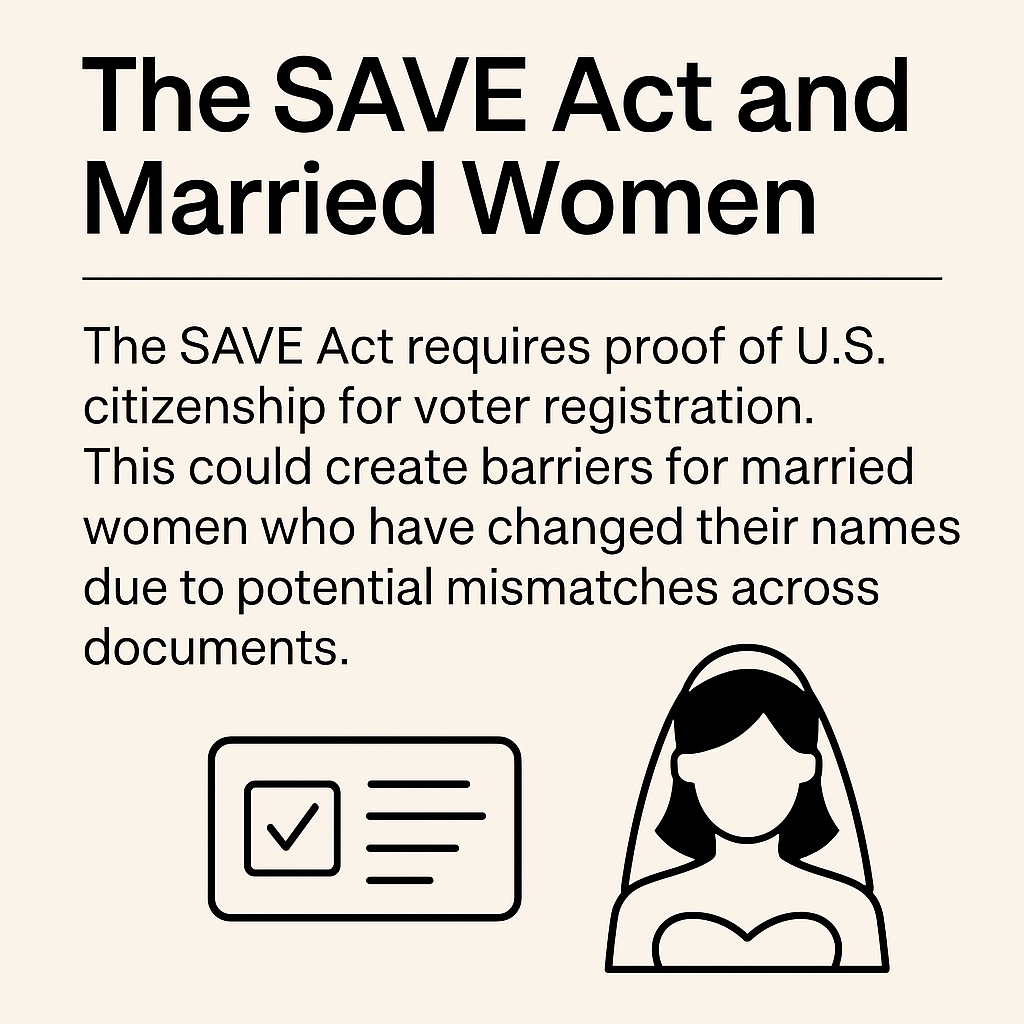
    The Safeguard American Voter Eligibility (SAVE) Act is a proposed federal law that would tighten voter registration requirements. In particular, it requires proof of U.S. citizenship to be presented in person when registering to vote or updating a registration. Acceptable documents under the SAVE Act include a U.S. passport, a U.S. birth certificate (paired with a valid photo ID), a naturalization certificate, certain military IDs with service records, or a state ID compliant with the REAL ID Act that indicates citizenship. Standard driver’s licenses or state IDs (which do not prove citizenship) would no longer be sufficient. This would effectively end popular registration methods like mail-in, online, and third-party voter registration drives, since people would have to appear in person at an election office with documents in hand.

    Importantly, the bill’s text does not list marriage certificates or legal name-change documents as acceptable forms of ID. This omission has raised alarms among voting rights advocates, because many voters’ current legal names do not match the names on their birth certificates or other citizenship documents. In particular, married women often change their last name after marriage, which could lead to a name mismatch between their primary proof-of-citizenship document (e.g. a birth certificate in their maiden name) and their current ID or voter registration record. Critics argue that the SAVE Act’s strict documentation rule would introduce a de facto name-matching requirement that may pose hurdles for these voters.

    Why Married Women Could Be Disproportionately Affected

    The concern centers on the prevalence of name changes after marriage. According to a Pew Research Center survey, about 79% of women who marry men take their husband’s last name, and another 5% hyphenate their surname; only a small minority keep their maiden name. Using these figures, analysts estimate that roughly 69 million women in the U.S. do not have a birth certificate that matches their current legal name. In other words, tens of millions of married women’s primary proof of citizenship (their birth record) shows a maiden name that no longer corresponds to the name under which they vote. By comparison, about 5% of married men change their name, affecting a few million male voters.

    Under the SAVE Act’s requirements, a voter whose birth certificate is in a different name might be unable to use that birth certificate alone to register, unless they also provide additional documentation. A U.S. passport could solve the problem (since passports are issued in one’s current name and are accepted as standalone proof). However, only roughly half of Americans have a valid passport, and passport application fees and processing times can be burdensome. Voters without a passport would have to rely on a birth certificate plus a secondary photo ID that exactly matches the birth certificate’s information. For a woman who changed her last name, this means her driver’s license or state ID would not match her maiden name on the birth certificate. In theory she could present a marriage certificate or court order to bridge the difference – but since the bill does not explicitly say that marriage licenses or name-change decrees will be accepted, it’s uncertain how such a case would be handled.

    Voting rights groups point out that this ambiguity creates a significant hurdle. VoteRiders, an organization that helps voters obtain ID, notes that a married woman in this situation “could not use their birth certificate to prove U.S. citizenship in order to register or update their registration” and would instead need a passport or other proof many people lack. The Center for American Progress similarly warns that the fate of those ~69 million women is “up in the air” under the bill as written. In short, critics argue the SAVE Act would force many women to gather additional documents (like passports or certified name-change papers) or else “get new IDs” in their married name that meet the new standards – a process that can be costly and time-consuming for the individuals affected.

    It’s worth noting that the overwhelming majority of people who change their names are women, so any strict ID/name matching requirement will hit women hardest. One analysis found that 34% of voting-age women lack ready access to a citizenship document showing their current name (for example, they may have a birth certificate or naturalization paper in a former name, and no updated passport). This figure reflects a real gap that could translate into registration problems if the law mandates matching documents.

    Historical Evidence of Name Mismatches in Voting

    Have name changes caused significant voting issues before? There is evidence that name mismatches have posed obstacles in past voting processes, especially under stricter ID or proof-of-citizenship laws:

    • Arizona’s Proof-of-Citizenship Law (2005–2013): After Arizona passed a 2004 law requiring documentary proof of citizenship to register (similar to what the SAVE Act proposes), thousands of eligible voters were blocked from the rolls. In Maricopa County alone, more than 10,000 people were prevented from registering to vote, and according to a county official, most of those were “probably U.S. citizens whose married names differ from their birth certificates or who have lost documentation”. In other words, married women who had taken a new last name were a large share of those caught up in Arizona’s paperwork requirement. (The Arizona law was later struck down by the U.S. Supreme Court in 2013 for conflicting with federal law.)
    • Texas Voter ID Law (2013): Texas implemented a strict photo ID law that, at first, required the name on a voter’s ID to exactly match the name on the voter registration rolls. This led to “unexpected consequences” for women voters. For example, women who had married and changed their names found themselves flagged at the polls. One Texas judge, who had used her maiden name as her middle name on her driver’s license, was told her ID did not perfectly match her voter registration (which listed her full given middle name). She had to sign an affidavit affirming her identity in order to vote. Early reports noted the law was “causing problems for some women, whose names changed because of marriage or divorce”. Texas eventually adjusted its procedures to allow “substantially similar” name matches (so that a maiden-to-married name change would not outright block a ballot), but the episode highlights that name inconsistencies can lead to real hassle or provisional voting requirements.
    • “Exact Match” Policies: In some states, voter registration systems have used “exact match” rules that compare registration forms against other government databases. These have also disproportionately flagged people who had name changes or hyphenations. For instance, past Georgia policies temporarily held up registrations for small discrepancies like a missing hyphen or an extra initial. Many of those caught by exact-match were women or naturalized citizens whose identification documents didn’t all use the exact same name format. Such policies have been challenged and reformed due to their disparate impact on eligible voters. They illustrate how rigid name matching can accidentally disenfranchise legitimate voters over minor paperwork issues.

    In summary, history shows that when laws require identity documents to line up perfectly, women who changed their names are often among the most affected. Even currently, in states with voter ID laws, women sometimes face extra hurdles if their ID name doesn’t exactly match the name on the voter rolls. They may be asked for a second ID, required to sign affidavits, or even turned away if they cannot resolve the discrepancy on the spot. This backdrop makes the concerns about the SAVE Act credible – it wouldn’t be the first time that a well-intentioned verification rule inadvertently made voting harder for married women.

    What Experts and Officials Are Saying

    Voting rights experts and civil rights groups have weighed in on the issue, largely voicing alarm that the SAVE Act’s documentation rules could disenfranchise or deter a significant number of legitimate voters. Here is a summary of viewpoints:

    • Election Law Scholars: Justin Levitt, a constitutional law professor and former voting rights advisor, notes that requiring extra documents “makes registering to vote harder — without any good reason for the extra difficulty”. He and others stress that the more paperwork and in-person steps you demand, the more likely some eligible voters will fall through the cracks (for example, those who can’t easily travel to county offices or can’t locate a specific document). Levitt also warns that giving local officials broad discretion to judge documentation could invite inconsistent or biased decisions, recalling “a pretty sad history of a few registrars abusing their discretion” before federal safeguards were in place.
    • Voting Rights and Civil Liberties Groups: Organizations like the Brennan Center for Justice, League of Women Voters, All Voting is Local, VoteRiders, and Stand Up America have all criticized the SAVE Act. They argue it would create new barriers for vulnerable groups – not only married women, but also divorced individuals, transgender people, and others who have changed their names, as well as naturalized citizens who might not have a U.S. birth certificate. Advocates emphasize that the bill is addressing a virtually nonexistent problem (non-citizens voting, which is already illegal and “extremely rare”) at the cost of making registration more cumbersome for millions of legitimate voters. Hannah Fried of All Voting is Local remarked, “It will make it so that people in this country who have every right to vote can’t vote, and for no good reason”. Similarly, Eliza Sweren-Becker of the Brennan Center points out the bill’s text doesn’t spell out clear rules for people with name changes, calling it an “extraordinary burden” on the registration process.
    • Concerns about Ambiguity: A major theme among experts is ambiguity in the bill’s provisions for name discrepancies. The SAVE Act does instruct states to set up a process for cases where an applicant’s documents have “a discrepancy… due to something like a name change.” This clause is often cited by the bill’s supporters as a safeguard. However, experts find it vague. Ceridwen Cherry, legal director at VoteRiders, notes that the bill “does not specify what documents would be accepted” as proof in those cases. The text says “additional documentation” may be provided but doesn’t list examples, leaving it up to each state to define what is enough. Cherry warns that this “ambiguity in the bill’s text presents the distinct possibility” that voters with a name mismatch (like a woman whose birth certificate is in her maiden name) “would not be offered the opportunity to provide supplementary documentation like a marriage certificate as part of the voter registration process.” In other words, there’s no guarantee every state would permit a simple marriage-license fix; some could, in theory, require a voter to get a passport or updated birth certificate name instead.
    • Election Officials and Enforcement: Another issue is the bill’s strict enforcement and penalties. The SAVE Act would make it a federal felony for an election official to register someone without the required citizenship proof. Wendy Weiser, vice president at the Brennan Center, points out that even if states create a name-change process, “how many election officials would be willing to risk incarceration and steep fines to register someone whose documentation does not match their current name?”. This chilling effect could mean officials err on the side of rejecting applications whenever there’s any doubt or discrepancy. In practice, a married voter whose documents aren’t straightforward might be turned away or told to come back with more proof, rather than given the benefit of the doubt. Weiser calls the bill’s supposed fail-safe for name changes *“a weak one” that “does not provide a meaningful failsafe for married women.”
    • Supporters of the Bill: The sponsors and supporters of the SAVE Act dispute the idea that it disenfranchises anyone. Congressman Chip Roy (R-Texas), the bill’s author, has called fears about married women “absurd armchair speculation.” He stresses that “the legislation provides a myriad [of] ways for people to prove citizenship and explicitly directs States to establish a process for individuals to register to vote if there are discrepancies … due to something like a name change.” Roy and others argue that as long as a person can prove their citizenship and their married status, they will be able to register. In their view, a woman with a maiden-name birth certificate could simply supply additional papers (like a marriage certificate or updated Social Security record) to verify that her new last name is still tied to the same citizen. “Providing proof of citizenship is not a new concept,” a House Administration Committee spokesperson said, noting that people already show such documents for things like obtaining REAL ID driver’s licenses.Supporters also point out that name-change documentation is routinely used in other contexts. Cleta Mitchell, a proponent of stricter voting laws, noted that “married women regularly have to provide birth certificates and marriage licenses in order to change their names for Social Security documents, bank accounts and other documents.” She acknowledged the process “is a pain,” but argued “millions of women do it every day.” From this perspective, the SAVE Act’s requirements are seen as an extension of standard bureaucratic procedures—an inconvenience, perhaps, but not an insurmountable barrier. In short, the bill’s defenders maintain that no eligible voter will be outright barred from voting due to a name change; they might just need to bring an extra document or two to confirm their identity and citizenship.
    • Lawmakers and Public Figures: Some public officials have framed the issue starkly. House Democratic Whip Katherine Clark claimed the act was essentially a way to “make it harder for women in this country to vote, who changed their names because they got married”, calling it “voter suppression wrapped up in some sort of immigration argument.” On the other side, former President Trump and certain Republican backers argue the law is needed to prevent illegal voting (despite little evidence of non-citizen voting). These political statements underscore how partisan the interpretation has become – with one side viewing the bill as protecting election integrity, and the other viewing it as an unnecessary constraint that will catch many innocent voters in its net.

    The Viral Claims and Their Credibility

    The debate over the SAVE Act’s impact on married women spilled onto social media, where some posts went viral with alarming claims. For example, in February 2025, a widely shared TikTok video asserted that “if you are a woman that has changed your name… you are no longer eligible to vote if this bill passes.” On Twitter (X), prominent activists warned that “8 in 10 married women” would be affected and claimed “69 million women would have to get new IDs to vote under the SAVE Act”, accusing the GOP of “trying to silence women across the country.”. These posts, often accompanied by the hashtag #HandsOffHerVote, generated intense discussion. Many readers understandably wondered if the SAVE Act truly amounted to a ban on voting for women who changed their names.

    Fact-checkers have responded to these viral assertions:

    • PolitiFact reviewed the TikTok claim and rated it “Mostly False.” They found that the claim contained “an element of truth” in that the bill’s requirements could indeed make registration harder for those who’ve changed their names (the vast majority of whom are women). However, it “ignores critical facts that give a different impression.” In reality, “the bill does not make women ineligible to vote if they have changed their names after marriage”, PolitiFact noted. It would not outright disqualify married women, because there are ways to complete the registration — for instance, by showing a passport or supplemental documents. The correct interpretation is that it introduces new hurdles and paperwork that could deter or delay some voters, but does not categorically bar women with new last names from voting. Simplified claims that married women “will not be able to register at all” are exaggerated.
    • FactCheck.org likewise addressed the question, responding that no, the SAVE Act would not explicitly prevent a married woman from registering due to a name change, as long as she provides the required proof of citizenship. The site emphasized that the bill does instruct states to have a process for mismatched names, but it agreed with voting advocates that ambiguity in the bill could lead to difficulties. FactCheck highlighted that it’s unclear which documents would be deemed acceptable in those cases, and it acknowledged the risk that in practice some women might face trouble if, say, a local official is unsure whether to accept a marriage certificate. In short, their assessment was that the worst-case scenario painted on social media (wholesale disenfranchisement of married women) is not guaranteed by the letter of the law – yet the concern is not unfounded either, because the law as proposed is unnecessarily onerous and imprecise in addressing name changes.
    • CBS News and Other Media also weighed in. CBS News Confirmed reported that while the social media claims were somewhat overstated, the underlying issue was real: “Experts say the bill… would not explicitly prevent these voters from casting a ballot, but it could create barriers to registration by requiring them to show additional documentation.” Their coverage included voices from both sides and reinforced that married people who changed their names would face added steps under the SAVE Act, even if they wouldn’t be outright banned. The Center for American Progress expert interviewed by CBS put it bluntly that without clearer provisions, “the fate of those 69 million women are basically up in the air, the way the bill is written.” Such reporting suggests that, at minimum, the risk of bureaucratic disenfranchisement (people being unable to vote due to paperwork technicalities) is taken seriously by nonpartisan observers.

    In evaluating the credibility of the concerns, it appears that the alarm raised online is based on legitimate facts (high numbers of women change their names and lack matching documents), but some posts presented the issue in a one-sided or hyperbolic way. The claim that the SAVE Act is a deliberate attempt to “silence” or target married women is an opinionated interpretation of lawmakers’ motives. What is objectively verifiable is that this bill would impose stricter documentation requirements than we’ve seen nationally, and those requirements would, by design, put voters who’ve changed their names through extra hurdles. There is broad agreement among neutral experts and fact-checkers that many women would be inconvenienced or put at risk of falling through the cracks, especially if they don’t have passports or easy access to their marriage papers. Whether one frames that as “disenfranchisement” might depend on how severe one believes the impact would be and how effectively states could mitigate the issues.

    Conclusion

    In summary, the SAVE Act does not explicitly bar married women (or any group) from voting, but its stringent proof-of-citizenship mandate could disproportionately burden women who changed their names after marriage. By requiring documents like birth certificates or passports for voter registration, the bill introduces a name-matching problem that affects tens of millions of married women whose legal names no longer match their birth records. History shows that such mismatches are not mere hypotheticals – they have caused real barriers under state-level voting laws in the past.

    Voting rights advocates, civil rights organizations, and nonpartisan experts have voiced serious concerns that the SAVE Act’s lack of clarity and its punitive approach to enforcement could lead to eligible voters being turned away – particularly women, as well as others with name changes (like transgender individuals and divorced persons). They argue that the bill addresses a virtually non-existent problem (non-citizen voting) at great cost to voter accessibility. These concerns are bolstered by data and were considered plausible enough to merit widespread media coverage and fact-checking.

    On the other hand, proponents of the law insist that it would not disenfranchise anyone who makes a reasonable effort to provide documentation. They point to the provision instructing states to accommodate name discrepancies, and note that millions of women manage legal name changes for other purposes regularly. In their view, the integrity gains (ensuring only citizens register to vote) outweigh the added inconvenience, which they see as surmountable. They contend the fears are exaggerated and politically driven.

    After examining the evidence, the truth lies somewhere in between the extremes of the debate. **The claim that the SAVE Act would outright “disqualify” married women from voting is overstated – married women could still register and vote, provided they jump through the necessary hoops. However, **the concern that many could be disenfranchised is not unfounded – in practice, some eligible voters may be unable to meet the new requirements or be discouraged by them. If the bill became law without clearer guidance, it’s conceivable that a woman lacking a passport and unaware of how to navigate the paperwork could be left off the rolls, at least temporarily.

    In evaluating the credibility of the viral warnings: they highlight a real potential impact (backed by solid statistics and precedent) but often failed to mention the caveats. Fact-checkers have rightly noted that the situation is more nuanced than social media soundbites suggest. The bottom line is that the SAVE Act would create additional hurdles to voter registration for anyone without perfectly aligned documents, and because of social patterns, married women as a group would face a disproportionate share of those hurdles. Those concerned about voting rights see this as a serious problem; those focused on election security believe it’s a manageable trade-off.

    For the general public, it’s important to understand both points: no, the bill doesn’t explicitly strip married women of their rights, but yes, it could make exercising those rights more complicated for a great many people. As the legislative debate continues, neutral observers will be watching to see if lawmakers address the name-match issue in the bill’s language. Until then, the caution raised by civil rights groups should be taken seriously, even if some of the most dramatic claims online may be somewhat overstated. All told, the credibility of the concerns is supported by data and expert analysis, but voters should also know that solutions (like bringing a passport or marriage certificate) would exist – albeit solutions that require time, effort, and access to documents that not everyone may readily have.

    Sources: Verified reports and analyses from PolitiFact, FactCheck.org, The 19th News, Center for American Progress, CBS News, and others have informed this overview. These sources provide a fact-checked basis for understanding how the SAVE Act’s technical requirements intersect with the reality of name changes and voter registration. The consensus among experts is that the issue is real and merits attention, even if the most extreme characterizations should be viewed with some skepticism.