
By: seeker of truth
Austin, TX (April 11, 2025) – A marathon episode of The Joe Rogan Experience this week turned into a fiery debate as British author Douglas Murray and American comedian Dave Smith clashed over the Israel–Palestine conflict, the value of expertise, media bias, and interpretations of history. The three-hour podcast (episode #2303), released April 10, has since spurred intense discussion online, with pundits and listeners dissecting the exchange’s key themes and fact-checking several bold claims.
Key Themes of the Murray–Smith Debate
Israel–Palestine Conflict Takes Center Stage
The heart of the debate was the ongoing war between Israel and Hamas in Gaza. Murray, a conservative journalist and staunch Israel defender, argued forcefully in support of Israel’s military response to Hamas. He described Hamas as an organization that “not only doesn’t follow the rules of war, but uses your following of the rules of war against you”, accusing the group of cynically embedding fighters among civilians to exploit Israel’s restraint. Murray contended that Hamas’s tactics ensure any Israeli counterattack incurs civilian casualties, which Hamas then uses as “fodder for international condemnation”. This strategy, he said, makes it appear Israel is acting barbarically when in reality Israel is fighting an enemy that “plays by no rules at all”.
Dave Smith – a libertarian comedian and outspoken critic of U.S. foreign policy – took a sharply different view. Smith lamented the humanitarian catastrophe in Gaza and questioned the morality of Israel’s heavy bombardment and blockade of the densely populated territory. He cited sobering statistics and reports to underscore the conflict’s human toll. For instance, by early April, Palestinian health officials estimated over 50,000 people had been killed in Gaza, nearly one-third of them children. (These figures dwarf the approximately 1,200 Israelis, mostly civilians, killed in Hamas’s initial October 7, 2024 attack.) Smith argued that such a lopsided casualty rate raises serious ethical questions about collective punishment and civilian suffering. He also referenced historical context – including past statements by U.S. officials – to suggest the Gaza crisis cannot be viewed in isolation. At one point, Smith brought up former NATO commander Wesley Clark’s claim that the U.S. had a post-9/11 plan to topple multiple Middle Eastern regimes, implying a broader pattern of Western military interventions fueling instability. Smith’s broader point was that Western policies, including unflinching support for Israel’s government, have long-term consequences that deserve scrutiny.
Throughout the exchange on Israel-Palestine, both men accused the other of one-sided narratives. Murray pressed Smith on whether he acknowledged Hamas’s role in Gaza’s suffering (such as diverting resources to terror infrastructure and using civilians as shields). Smith, in turn, challenged Murray on Israel’s blockade and military tactics, highlighting what he sees as a refusal to admit any Israeli wrongdoing or the desperation driving Palestinian resistance. The debate grew heated as they sparred over historical grievances – from the founding of Israel to previous conflicts – each accusing the other of cherry-picking history. At one juncture, Murray noted that Smith had never actually visited Israel or Gaza despite spending “18 months pontificating on the conflict,” a barb suggesting Smith’s understanding was secondhand. Smith countered that one need not have “set foot in Gaza” to recognize humanitarian crises or moral issues at play, asserting “I can still have an informed opinion”. The tension underscored how personal experience and identity were being used as debating points in an argument ostensibly about facts on the ground.
Who Gets to Speak? The Role of Expertise vs. Open Debate
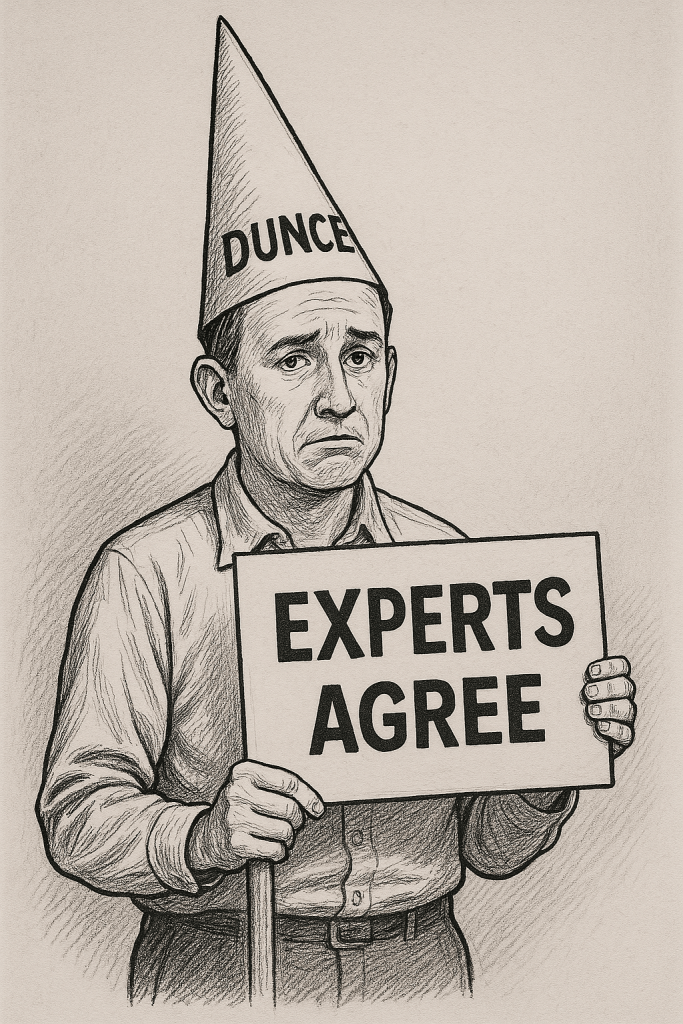
A recurring theme, especially in the podcast’s early portion, was who is qualified to weigh in on complex issues. Murray opened the conversation by pointedly questioning Rogan’s choice of guests on wars in Ukraine and Gaza. He noted that since the wars began, Rogan’s show has hosted “quite a lot of people who are very against [Western positions],” but relatively few authoritative voices from the pro-Ukraine or pro-Israel side. Murray’s critique was blunt: Rogan has given fringe commentators a megaphone, thereby mainstreaming alternative narratives without adequate pushback. “It’s weird to mainstream very fringe views constantly, and not give another side,” Murray said, confronting Rogan directly. He took issue with guests who “appointed themselves as experts, who are not experts” pontificating on geopolitical events.
As examples, Murray brought up two controversial figures Rogan had hosted: Ian Carroll and Darryl Cooper. Carroll, whom Murray labeled a “conspiracy theorist,” appeared on JRE to discuss historical conspiracies. “If you’re going to interview historians of the conflict… why would you get somebody like Ian Carroll?” Murray challenged Rogandaily. He also cited Cooper, an amateur history podcaster who had made the incendiary claim that Winston Churchill was “the chief villain of World War II.” Murray argued that giving a platform to such revisionist takes – effectively “throwing out counter-historical stuff of a very dangerous kind” – misleads the audience. In Murray’s view, Rogan’s friendly, uncritical style enabled dubious assertions to go uncorrected. “At some point, ‘I’m just asking questions’ is not a valid thing,” he said of the conspiratorial tone some guests take. “You’re not asking questions. You’re telling people something,” Murray warned, implying that under the guise of open inquiry, misinformation was spreading.
Both Rogan and Dave Smith pushed back on Murray’s gatekeeping. Smith, in particular, mounted a defense of free discourse. “I’m not an expert, but that doesn’t mean I can’t have my take,” he argued. Smith contended that everyday people must be allowed to debate foreign policy since these issues ultimately affect everyone, not just academics or officials. He characterized Murray’s deference to establishment “experts” as elitist and overly dismissive of dissenting voices. Rogan also defended his booking choices, saying he invites guests who interest him rather than to satisfy a quota of viewpoints. The podcast host – who has been a comedian, UFC commentator, and self-described layman – admitted his recent guest list on geopolitical topics “probably [has] tilted” toward critics of U.S. and Israeli actions. However, Rogan insisted this was not by design; he suggested it reflects his genuine curiosity about outsiders challenging mainstream narratives. Smith seconded that perspective, suggesting that figures like Darryl Cooper simply use long-form podcasts to explain their worldview in detail, which traditional media seldom allows.
The disagreement over expertise vs. open dialogue speaks to a broader tension. Murray’s side argued that platforming uncredentialed commentators can lend undue credibility to fringe theories, risking the spread of false or “dangerously off” counter-narratives (for example, downplaying Hitler’s evil in World War II). Smith’s side argued that distrust in establishment experts stems from those experts’ failures – citing instances like the Iraq War’s false WMD claims or public health authorities’ shifting COVID guidance – and that alternative voices offer healthy skepticism. The two positions underscore a paradox noted by some observers: Rogan’s anti-establishment appeal has drawn such a massive audience that his show is now de facto a mainstream source of information. In that light, the debate raised the question of responsibility: should a platform as influential as Rogan’s stick to credentialed experts, or continue amplifying fringe dissenters as a “free speech” forum? The episode itself didn’t settle that question, but it vividly illustrated the divide.
Media Narratives and Historical Interpretation
Interwoven with the above was a critique of media bias and historical narratives. Murray repeatedly alluded to what he perceives as revisionist history being promoted on Rogan and similar platforms. He cited Darryl Cooper’s World War II take on Churchill as one example of “wildly off” counter-history that went mostly unchallenged. Murray’s concern was that in an atmosphere skeptical of “official narratives,” even well-established historical facts (like Nazi Germany being the chief aggressor of WWII) can be distorted by provocateurs. He argued that Rogan’s ecosystem sometimes treats “pseudoscience, junk history and conspiracy theories” as forbidden knowledge that the mainstream hides. This, Murray suggests, is a dangerous trend: fringe ideas gain mainstream traction without the context that professional scholarship or journalism might provide.
Smith, however, turned the mirror back on establishment media. He suggested that mainstream networks and government-aligned experts have their own narrative biases – often downplaying inconvenient truths or alternative perspectives. On the Israel-Gaza issue, Smith noted, the dominant Western media narrative tends to emphasize Israel’s security and Hamas’s terrorism (which he doesn’t deny), but often gives short shrift to Palestinian civilian suffering or historical grievances. Smith referenced statements from Israeli officials and international reports that rarely make U.S. headlines, such as those acknowledging the humanitarian impact of the Gaza blockade. For example, he pointed to data (from sources like the World Bank and United Nations) showing Gaza’s economic collapse and dire living conditions. He also invoked incidents like the Israeli military’s strikes on civilian areas and the high number of children killed, arguing these facts deserve as much attention as Hamas’s atrocities. In essence, Smith’s stance was that challenging “official” narratives is necessary for a fuller truth, even if some alternative claims end up being wrong.
The two guests additionally sparred over analogies and historical comparisons. At one point the Holocaust was discussed – not in terms of denying it happened (both clearly accept that historical fact), but regarding how Holocaust history is invoked. Murray bristled at what he sees as trivialization or misrepresentation of Nazi-era facts by fringe commentators (for instance, any rhetoric that might downplay Hitler’s anti-Semitism or the uniqueness of the Holocaust as a historical evil). Smith agreed the Holocaust is uniquely horrific, but he cautioned against using accusations of antisemitism to silence all criticism of Israel’s current government. The debate thus touched on a delicate issue: how historical traumas (like World War II or 9/11) shape current policy arguments. Murray’s view was that certain comparisons or doubts (e.g. implying today’s Israel is behaving like past aggressors) are “counter-narratives” that cross into distortion, whereas Smith maintained that examining history – even inconvenient aspects of one’s own side – is essential to avoid repeating mistakes.
Public Sentiment and Social Media Reaction
The Murray vs. Smith showdown quickly spilled beyond the studio, igniting widespread reactions on social media and discussion forums. Public sentiment has been sharply divided, reflecting broader ideological fault lines:
- On X (formerly Twitter): Prominent voices and ordinary listeners alike took to the platform to declare a winner and air grievances. Many pro-Israel and conservative commentators praised Douglas Murray for forcefully pushing back on Rogan and Smith. “Douglas Murray just called out Joe Rogan in a major way… seeing him squirm here is hilarious,” wrote one user, applauding the British writer for confronting Rogan on his own show. Another X user quipped that “Dave Smith tried to match wits with Douglas Murray… It wasn’t a fair fight because Dave and Joe were both unarmed,” implying Murray’s command of facts far outmatched Smith’s. These supporters argue that Murray brought much-needed intellectual rigor and exposed what they view as Rogan’s and Smith’s shallow understanding of the conflicts. On the other side, libertarian and anti-war commentators lionized Dave Smith for standing his ground against a seasoned intellectual. “Douglas Murray… seems like such a tool. It’s easy to win debates when you are correct, not so easy when you are wrong,” one fan wrote, adding, “Glad @ComicDaveSmith called out all the appeals to authority” – a clear cheer for Smith’s challenges to Murray’s expert-driven arguments. Pro-Palestinian activists and skeptics of mainstream media also rallied behind Smith. Some characterized the debate as a David vs. Goliath encounter, with Smith (the outsider) boldly questioning a well-connected establishment figure. A viral tweet from a pro-Palestine account declared the episode a “must-watch”, claiming “Dave [Smith] intellectually cooks Douglas [Murray], exposing flaws in the pro-Israel narrative with facts and moral clarity”, and urging viewers tired of one-sided takes to tune in (accompanied by hashtags like #IsraelPalestine #ProPalestine #Truth). Such posts cast Smith as articulating what many have felt but seldom heard on a large platform. The divide on X often broke along ideological lines. Right-leaning users aligned with neoconservative views echoed Murray’s warnings about “fringe misinformation”. More populist right and left-libertarian users sided with Smith’s anti-war stance, some even thanking Rogan for featuring an anti-Zionist voice. Notably, Sam Harris – a public intellectual and former Rogan guest – weighed in on social media with scathing criticism of Rogan and Smith. Harris, who is vehemently pro-Ukraine and pro-Israel, accused Rogan of being “in over his head on so many topics of great consequence” and slammed Smith as “a pure misinformation artist” riding Rogan’s platform. His comments, in turn, sparked their own debate: Harris’s supporters agreed, saying the episode proved Rogan lets misleading claims go unchecked, while Rogan’s defenders and libertarians fired back that Harris was simply upset his viewpoint wasn’t prevailing. The Harris-Smith feud (which even led to a brief war of words on X) highlighted how the podcast confrontation has become a proxy battle in the culture war over who gets to shape narratives – mainstream academics or alternative media figures.
- Reddit and Online Forums: On Reddit, multiple threads dissected the episode, attracting thousands of comments. In the r/JoeRogan subreddit, which boasts a diverse mix of Rogan fans, the discussion was intense and mixed. According to user reports, one top comment described Murray’s opening questioning of Rogan as “passive aggressive,” suggesting some Rogan loyalists bristled at their host being put on the spot. “Murray starts immediately questioning Joe… about how few pro-Israeli guests he has – it came off as smug,” wrote one Redditor, who felt Murray’s tone was off-putting. Others on that thread, however, applauded Murray’s points even if they found his style prickly. “Uncomfortable but necessary conversation,” read one highly upvoted remark, “Rogan needed to hear this.” Several users noted Rogan appeared defensive under Murray’s grilling, an unusual dynamic given Rogan’s typical role as a confident facilitator. This prompted debate over whether Rogan adequately defended himself or if he conceded too much to Murray’s critique. On issue substance, Rogan’s subreddit commenters seemed split much like Twitter. Libertarian-leaning participants praised Smith’s knowledge on foreign policy (some remarked they were impressed a comedian could “dismantle a neocon argument” with data), whereas others criticized Smith’s lack of firsthand experience, echoing Murray’s point that Smith had never been to the region. The phrase “armchair expert” came up frequently – with camps arguing over whether it applied more to Smith (an armchair foreign policy pundit) or to the academics Murray dislikes (armchair strategists detached from ground realities). Meanwhile, the r/samharris subreddit and other forums sympathetic to Harris or mainstream perspectives overwhelmingly sided with Murray. Users there framed the debate as “a long overdue fact-check” on Rogan and Smith, applauding Murray for “holding Rogan’s feet to the fire” about platforming questionable narratives. “This is exactly what Sam Harris was talking about,” one commenter wrote, linking Murray’s points to Harris’s recent critiques of Rogan’s show. In these circles, Murray’s appearance was seen as a corrective moment – with one user commenting that “libertarians and ‘anti-woke’ folks got a reality check from Murray on just how far off-base their historical takes are.” By contrast, left-wing forums (e.g. certain r/politics discussions) found themselves in the unusual position of cheering some of Dave Smith’s arguments. Progressive users, typically no fans of Rogan or libertarians, noted that Smith’s anti-war, pro-Palestinian arguments mirrored those long made by the Left. “Strange to agree with Dave Smith, but here we are,” one Reddit user mused, adding that establishment voices like Murray “needed to hear that not everyone buys the official story.”
- YouTube Comments: The YouTube upload of the episode on Rogan’s channel quickly amassed tens of thousands of comments, reflecting the video’s virality (it trended in the politics category with over 1 million views in its first day). The top comment on the video captured the humorous takeaway of many viewers: “I love when they ask Douglas a question, and he responds with an exhausted sigh as if he can’t believe he has to explain himself.” Indeed, throughout the debate Murray often sighed or showed visible frustration when refuting Smith or clarifying a point – a demeanor that supporters found amusingly patronizing and critics found arrogant. That comment alone garnered thousands of likes, indicating a segment of the audience was entertained by Murray’s professorial exasperation. Other highly-rated comments, however, celebrated the substance over the drama. “Best JRE episode in ages – real debate, not an echo chamber,” read one, with many agreeing that hearing two sharply different views on Rogan’s platform was refreshing. Fans of Smith flooded the comments with praise for his composure and depth of knowledge: “Dave Smith brought receipts,” one wrote, referring to his citations of reports and history, “He made his case without resorting to insults.” Conversely, Murray’s fans in the comments lauded his eloquence and command of facts, saying the episode was like a “masterclass” in dissecting flawed arguments. “Whether you agree with Murray or not, you have to admit he came extremely prepared,” a commenter observed, noting that Murray’s extensive background in reporting from conflict zones (Ukraine, Gaza) showed in the discussion. A number of viewers also gave credit to Rogan for hosting such a debate at all. “Props to Joe for letting this play out and not shutting it down,” read one comment, “We need more conversations like this in today’s media.” That said, the YouTube discourse was not without vitriol. Some threads devolved into insults – with partisan viewers hurling labels like “terrorist sympathizer” at Smith or “warmonger” at Murray. A few conspiracy-tinged comments accused Murray of being a mouthpiece for military-industrial interests, while on the flip side, some accused Rogan and Smith of spreading propaganda for Hamas or Russia. Moderators noted an uptick in heated flags, but overall the conversation remained one of the most engaged that a JRE episode has produced in recent memory. The breadth of the YouTube feedback — from thoughtful analyses to meme-worthy one-liners — mirrored the larger public conversation: deeply divided, but undeniably invested in the issues raised.
Fact-Checking Notable Claims and Narratives
Given the controversial nature of the debate, numerous fact-checks have emerged examining statements from the episode and subsequent social media reactions. Here is a look at several key claims and the evidence surrounding them:
- Claim: “Fringe commentators on Rogan have pushed dangerous revisionist history (e.g. ‘Churchill was the chief villain of WWII’).”
Verdict: Largely True (with context). This claim was highlighted by Douglas Murray, referencing guest Darryl Cooper’s extreme characterization of British Prime Minister Winston Churchill. Historians overwhelmingly reject the notion that Churchill was the primary villain of World War II – that label belongs to the Nazi leadership; Churchill in fact led the fight against Hitler. Murray’s point underscored that such a view is historically fringe. Indeed, Cooper’s comment about Churchill, which he made on a different podcast before reiterating it on Rogan, has been widely criticized as a distortion. Murray argued that allowing such claims on a huge platform without robust rebuttal is misleading. While Rogan and Smith defended Cooper’s right to his opinion, it’s worth noting that mainstream scholarship strongly contradicts Cooper’s revisionism. In sum, Murray’s warning about “dangerous counter-historical stuff” has merit – the Churchill claim is an outlier view with no support among World War II experts. Rogan’s show did acknowledge it as controversial, but critics say it wasn’t sufficiently challenged in the moment. - Claim: “Israel’s war in Gaza has killed tens of thousands of civilians, including a disproportionate number of children.”
Verdict: True (according to official sources, though Israel disputes intent). Dave Smith and many online supporters repeatedly cited the civilian death toll in Gaza to argue Israel’s response to Hamas is indiscriminate or excessive. According to data from the Palestinian Ministry of Health (as relayed by reputable outlets like Reuters), the death toll in Gaza from Israeli military operations since October 2024 exceeds 50,000 people, of whom roughly 30% are minors. This is an enormous number that humanitarian organizations have also reported, though Israel has questioned the reliability of Hamas-linked health authorities’ figures. Even allowing for potential inflation, independent assessments by the United Nations and others confirm massive civilian casualties and widespread destruction in Gaza. Israel’s military acknowledges thousands of non-combatants have died, while insisting it tries to minimize civilian harm and blaming Hamas for using civilians as shields. No credible evidence contradicts the general scale of the tragedy – by far the highest Gaza death toll in any of the conflicts to date. Thus, Smith’s emphasis on the humanitarian toll is grounded in reported facts. The key nuance is why that toll is so high: Murray asserts it’s chiefly due to Hamas’s tactics, whereas Smith points to Israel’s siege and bombardment policies. Those interpretations differ, but the raw numbers cited are unfortunately real. - Claim: “Hamas uses human shields and deliberately exploits Israel’s adherence to international norms.”
Verdict: True (widely documented). This was a central argument by Douglas Murray, and it aligns with reports from human rights monitors and military analysts. Hamas has a well-documented history of embedding its fighters and weapons in civilian areas – launching rockets from residential blocks, storing munitions in or near hospitals and schools, and using civilian infrastructure as cover. The group’s leaders have even tacitly admitted they use the population’s density to their advantage. Murray’s phrasing – “a force that… uses your following of the rules of war against you” – reflects a view shared by many counter-terror experts. By international law, militaries are expected to avoid civilian casualties; Hamas exploits this by making targets hard to strike without collateral damage. Evidence: The Israeli army has released videos of secondary explosions in apartment blocks (implying hidden arms depots) and intercepted Hamas battle plans referring to civilian cover. Independent analysts note that Hamas’s headquarters is believed to be under Gaza’s main hospital, and the group has been accused by the UN of storing weapons in U.N.-run schools in past conflicts. Therefore, Murray’s claim is backed by evidence and is a significant factor complicating the conflict. However, fact-checkers also note that this reality does not absolve Israel of all responsibility under the laws of war. Deliberately or not, Israeli strikes have hit numerous civilian sites (including hospitals, schools, markets), raising questions from the UN and others about proportionality. So while Hamas’s human shield strategy is real, whether Israel’s response has been appropriately measured is a separate matter (one hotly debated by Murray and Smith). - Claim: “Joe Rogan’s guest lineup on Ukraine and Israel has been one-sided, favoring critics of Western policy.”
Verdict: True, by Rogan’s own admission. Murray charged Rogan with a lineup bias, and Rogan conceded on air that his show probably “tilted… more towards” guests critical of efforts in Ukraine and Israel. A review of recent JRE episodes confirms that since the Ukraine war began in 2022 and the Israel-Gaza war in 2024, Rogan has indeed hosted several high-profile skeptics of U.S. foreign policy (e.g. Elon Musk discussing Ukraine, RFK Jr. on foreign wars, and multiple vocal critics of Israeli actions including Dave Smith himself, plus others like Max Blumenthal). By contrast, pro-establishment voices (such as staunch Ukraine or Israel supporters) have been fewer. Rogan named psychologist Jordan Peterson and author Gad Saad as two guests who defended Israel, but those were exceptions and neither is a military or regional expert. Thus, Murray’s implication that Rogan’s booking tilts anti-establishment is correct. However, Rogan’s selection seems organic rather than conspiratorial – he tends to feature people from his personal network or who spark his interest in contrarian takes. The “one-sided” nature may be real, but Rogan argues it’s not intentional advocacy. Still, the fact-check stands: listeners have mainly heard critiques of Ukraine’s and Israel’s war policies on JRE, with far fewer voices representing the opposing viewpoint. Murray’s call for more balance is based on an accurate observation of the guest roster. - Claim: “Dave Smith spreads misinformation about Israel and was treated as an expert on Rogan’s show.”
Verdict: Mixed/Unproven. This claim comes from Sam Harris’s sharp rebuke of Rogan and Smith, in which Harris labeled Smith “a pure misinformation artist” and suggested Rogan presented him as an expert on Israel. Evaluating this requires looking at specific allegations of misinformation. While Smith undeniably has a strong viewpoint, during the debate itself he backed many assertions with sources (for example, casualty statistics from reputable outlets, references to known historical events, etc.). We did not find clear instances in the episode where Smith stated a provable falsehood about geopolitical facts. His detractors might argue that Smith’s framing – such as emphasizing Israeli actions as aggressive while downplaying Hamas’s role – is misleading or lacking context. But framing is different from outright false information. In response to Harris, Smith’s supporters note that Harris did not cite a particular false claim by Smith, making the charge somewhat generic. It’s possible Harris was referring to comments Smith made in other venues (for instance, Smith has speculated about U.S. foreign policy motives in ways Harris finds conspiratorial). As for being “treated as an expert,” Rogan did give Smith the floor to explain the Israel-Palestine history, but also openly acknowledged Smith isn’t a credentialed expert – that was part of Murray’s critique. In summary, labeling Smith a misinformation spreader is a matter of perspective. No concrete falsehood from Smith in this JRE episode has been identified in fact-checks; most of his claims (civilian deaths, blockade hardships, U.S. policy history) check out or fall within reasonable debate. Yet, those who disagree with Smith’s interpretations may view his narrative as informationally one-sided, which they dub “misinformation.” This claim thus lands in a gray area absent specific examples – it reflects a fierce disagreement over narrative rather than a clear fact/fake dichotomy.
A Mirror of Ideological Divides
Beyond the factual claims, what’s striking about the Murray–Smith debate is how it has become a Rorschach test for different political and ideological communities. Each segment of the audience seems to have viewed the same conversation through very different lenses:
- Conservative Establishment vs. Anti-war Right: As one analysis in UnHerd noted, this showdown epitomized a fault line on the political Right. Murray, a self-described neoconservative, represented the traditionally hawkish conservative camp that supports U.S. interventions (in Ukraine, backing Israel, etc.) and trusts Western institutions. Smith embodied the libertarian and “America First” right-wingers who are skeptical of wars and foreign entanglements, even when waged by conservative governments. The clash laid bare how divided the Right is post-Trump era: one faction stands with international alliances and expertise (Murray quipped during the podcast that Smith is “now mainly talking about Israel” despite being a comedian, jabbing that he’s out of depth), while the other faction challenges that very elite-driven outlook. Many on the populist right celebrated Smith for voicing what they feel – that endless wars and one-sided media coverage must be questioned. Meanwhile, establishment-aligned conservatives applauded Murray for defending core principles (supporting allies like Israel, respecting expertise, confronting conspiracies). Each side saw their champion “win” the debate: libertarian forums crowned Smith the victor, while neoconservative commentators like those at National Review or on Fox News praised Murray’s performance. The debate thus highlighted a civil war of ideas on the right, over issues of war, isolationism vs. interventionism, and who holds truth.
- Mainstream Media and Experts: Members of the foreign policy establishment and mainstream media figures largely sided with Murray’s critique of Rogan’s platform. They view the proliferation of “just asking questions” podcast discussions as a threat to informed public discourse. From this perspective, Murray’s on-air challenge was a welcome accountability moment. In fact, outlets such as Newsweek and major newspapers picked up the story, some framing it as Rogan being “called out” for hosting fringe voices. These reports often quote Murray’s lines about fringe voices gaining credibility without counterpoint. The subtext is a validation of the expert class: that yes, expertise and fact-checking matter and someone needed to say that to Rogan. Sam Harris’s vocal agreement with Murray’s points amplified this sentiment in intellectual circles. For their part, Rogan and Smith supporters push back that mainstream media has lost credibility – a sentiment that Rogan’s enormous following attests to. In the debate’s aftermath, think-tank scholars and journalists wrote op-eds either commending Murray or defending Rogan. The episode became a case study in the ongoing friction between legacy media values and new media populism.
- Progressives and the Anti-war Left: Interestingly, many on the left found themselves nodding along with portions of both Smith’s and Murray’s arguments – an illustration of horseshoe overlap on specific issues. Progressive anti-war activists certainly share Smith’s outrage at the humanitarian cost in Gaza and have been among the loudest critics of Israeli government policies. They likely cheered Smith’s pro-Palestinian advocacy on such a prominent stage. On the other hand, some left-leaning commentators who distrust Rogan for platforming COVID skeptics or far-right figures found Murray’s critique of misinformation resonant. A writer in The Guardian might not usually side with Douglas Murray (who is known for conservative views on other topics), but in this instance might agree that Rogan should be more responsible with his platform. Thus, the debate created odd bedfellows: a libertarian and a leftist can agree Rogan’s critics are overblown, or a neoconservative and a liberal can agree Rogan needs balancing voices. It showcased how issue-based coalitions form in our fragmented discourse – pro-Palestine unity across left and paleocon right on one hand, pro-expertise unity across center-left and neocon right on the other. Each community cherry-picked aspects of the debate that validated their worldview.
- Joe Rogan’s Audience: Finally, the interpretations within Rogan’s massive fanbase are worth noting. Rogan’s listeners span across the spectrum, which is why this debate has caused such a stir; it pressed hot-button issues that different segments care deeply about (free speech, mistrust of media, support for Israel, etc.). Some longtime fans felt Rogan was “bullied” by Murray and should have defended himself or his guests more vigorously. Others felt Rogan did the right thing by letting the conversation flow and were glad to see him “learning in real time” – as one tweet put it, “the first hour is Joe Rogan discovering Douglas Murray doesn’t buy his usual angle.” Rogan himself has not publicly taken sides post-show; he rarely does, preferring to “let the audience decide.” And decide they have: polls on fan forums are split as to who “won” the debate. What’s clear is that the episode succeeded in sparking exactly the kind of public reasoning Rogan often says he hopes to encourage. Listeners are poring over sources, arguing in comment sections, and, as evidenced above, engaging with news and research to fact-check claims. In an age of polarized soundbites, a three-hour nuanced (if heated) discussion breaking into the mainstream is a rarity.
Conclusion
The Douglas Murray vs. Dave Smith encounter on Joe Rogan’s podcast has proven to be much more than an on-air disagreement – it’s become a flashpoint in the conversation about truth, expertise, and perspective in modern media. The debate delved into one of the world’s most polarizing conflicts and, in doing so, held up a mirror to our information ecosystem: Are we better off trusting credentialed experts or independent voices? How do we balance open debate with factual rigor? And what narratives do we embrace about conflicts like Israel-Palestine – those of established allies, or those of dissenting observers?
In journalistic terms, the episode offered a rare spectacle: a top podcaster challenged on bias on his own show, two ideological opposites hashing out wars and history at length, and an engaged public reacting in real time with both applause and criticism. It blurred the line between media and audience, as the conversation continued on X, Reddit, YouTube and beyond, with each faction extracting its own lessons. As a commentary in UnHerd noted, by staging such debates Rogan provides a service – letting arguments be tested openly – but the ultimate judgment is left to the millions of listeners. In this case, those listeners are anything but monolithic in their verdicts.
What is undisputed is that this episode struck a chord. In an era when so many discussions of Israel-Palestine, or “misinformation,” devolve into echo chambers, the Rogan podcast became an unlikely commons where views clashed directly. Both Murray and Smith came armed with deeply held convictions and plenty of evidence for their side. Neither left the table with the other’s agreement – but perhaps that was never the goal. As Murray himself conceded in a thoughtful moment, forums like Rogan’s may not resolve such issues neatly, yet “at least [they give] both sides an opportunity to test their arguments and challenge the other”. For many listeners, that may be the real takeaway: in a politically fractured time, the conversation must continue, even if it’s messy. The episode, and the discourse it generated, underscores that understanding complex conflicts requires hearing competing narratives – and then diligently verifying the facts. In the end, the truth is what the public, sifting through debates like this one, can discern for themselves.


 Seeking Truth