
by: seeker of truth
Background: What Is the SAVE Act?
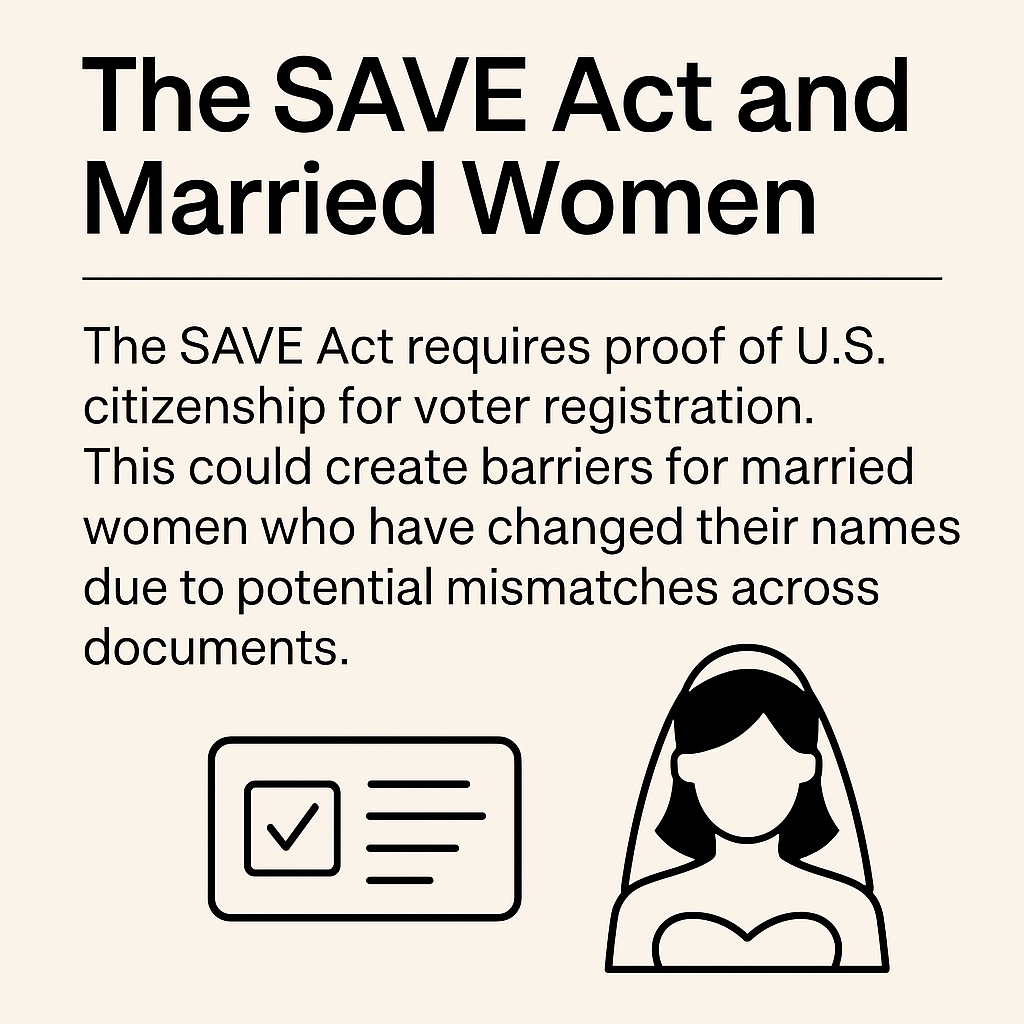
The Safeguard American Voter Eligibility (SAVE) Act is a proposed federal law that would tighten voter registration requirements. In particular, it requires proof of U.S. citizenship to be presented in person when registering to vote or updating a registration. Acceptable documents under the SAVE Act include a U.S. passport, a U.S. birth certificate (paired with a valid photo ID), a naturalization certificate, certain military IDs with service records, or a state ID compliant with the REAL ID Act that indicates citizenship. Standard driver’s licenses or state IDs (which do not prove citizenship) would no longer be sufficient. This would effectively end popular registration methods like mail-in, online, and third-party voter registration drives, since people would have to appear in person at an election office with documents in hand.
Importantly, the bill’s text does not list marriage certificates or legal name-change documents as acceptable forms of ID. This omission has raised alarms among voting rights advocates, because many voters’ current legal names do not match the names on their birth certificates or other citizenship documents. In particular, married women often change their last name after marriage, which could lead to a name mismatch between their primary proof-of-citizenship document (e.g. a birth certificate in their maiden name) and their current ID or voter registration record. Critics argue that the SAVE Act’s strict documentation rule would introduce a de facto name-matching requirement that may pose hurdles for these voters.
Why Married Women Could Be Disproportionately Affected
The concern centers on the prevalence of name changes after marriage. According to a Pew Research Center survey, about 79% of women who marry men take their husband’s last name, and another 5% hyphenate their surname; only a small minority keep their maiden name. Using these figures, analysts estimate that roughly 69 million women in the U.S. do not have a birth certificate that matches their current legal name. In other words, tens of millions of married women’s primary proof of citizenship (their birth record) shows a maiden name that no longer corresponds to the name under which they vote. By comparison, about 5% of married men change their name, affecting a few million male voters.
Under the SAVE Act’s requirements, a voter whose birth certificate is in a different name might be unable to use that birth certificate alone to register, unless they also provide additional documentation. A U.S. passport could solve the problem (since passports are issued in one’s current name and are accepted as standalone proof). However, only roughly half of Americans have a valid passport, and passport application fees and processing times can be burdensome. Voters without a passport would have to rely on a birth certificate plus a secondary photo ID that exactly matches the birth certificate’s information. For a woman who changed her last name, this means her driver’s license or state ID would not match her maiden name on the birth certificate. In theory she could present a marriage certificate or court order to bridge the difference – but since the bill does not explicitly say that marriage licenses or name-change decrees will be accepted, it’s uncertain how such a case would be handled.
Voting rights groups point out that this ambiguity creates a significant hurdle. VoteRiders, an organization that helps voters obtain ID, notes that a married woman in this situation “could not use their birth certificate to prove U.S. citizenship in order to register or update their registration” and would instead need a passport or other proof many people lack. The Center for American Progress similarly warns that the fate of those ~69 million women is “up in the air” under the bill as written. In short, critics argue the SAVE Act would force many women to gather additional documents (like passports or certified name-change papers) or else “get new IDs” in their married name that meet the new standards – a process that can be costly and time-consuming for the individuals affected.
It’s worth noting that the overwhelming majority of people who change their names are women, so any strict ID/name matching requirement will hit women hardest. One analysis found that 34% of voting-age women lack ready access to a citizenship document showing their current name (for example, they may have a birth certificate or naturalization paper in a former name, and no updated passport). This figure reflects a real gap that could translate into registration problems if the law mandates matching documents.
Historical Evidence of Name Mismatches in Voting
Have name changes caused significant voting issues before? There is evidence that name mismatches have posed obstacles in past voting processes, especially under stricter ID or proof-of-citizenship laws:
- Arizona’s Proof-of-Citizenship Law (2005–2013): After Arizona passed a 2004 law requiring documentary proof of citizenship to register (similar to what the SAVE Act proposes), thousands of eligible voters were blocked from the rolls. In Maricopa County alone, more than 10,000 people were prevented from registering to vote, and according to a county official, most of those were “probably U.S. citizens whose married names differ from their birth certificates or who have lost documentation”. In other words, married women who had taken a new last name were a large share of those caught up in Arizona’s paperwork requirement. (The Arizona law was later struck down by the U.S. Supreme Court in 2013 for conflicting with federal law.)
- Texas Voter ID Law (2013): Texas implemented a strict photo ID law that, at first, required the name on a voter’s ID to exactly match the name on the voter registration rolls. This led to “unexpected consequences” for women voters. For example, women who had married and changed their names found themselves flagged at the polls. One Texas judge, who had used her maiden name as her middle name on her driver’s license, was told her ID did not perfectly match her voter registration (which listed her full given middle name). She had to sign an affidavit affirming her identity in order to vote. Early reports noted the law was “causing problems for some women, whose names changed because of marriage or divorce”. Texas eventually adjusted its procedures to allow “substantially similar” name matches (so that a maiden-to-married name change would not outright block a ballot), but the episode highlights that name inconsistencies can lead to real hassle or provisional voting requirements.
- “Exact Match” Policies: In some states, voter registration systems have used “exact match” rules that compare registration forms against other government databases. These have also disproportionately flagged people who had name changes or hyphenations. For instance, past Georgia policies temporarily held up registrations for small discrepancies like a missing hyphen or an extra initial. Many of those caught by exact-match were women or naturalized citizens whose identification documents didn’t all use the exact same name format. Such policies have been challenged and reformed due to their disparate impact on eligible voters. They illustrate how rigid name matching can accidentally disenfranchise legitimate voters over minor paperwork issues.
In summary, history shows that when laws require identity documents to line up perfectly, women who changed their names are often among the most affected. Even currently, in states with voter ID laws, women sometimes face extra hurdles if their ID name doesn’t exactly match the name on the voter rolls. They may be asked for a second ID, required to sign affidavits, or even turned away if they cannot resolve the discrepancy on the spot. This backdrop makes the concerns about the SAVE Act credible – it wouldn’t be the first time that a well-intentioned verification rule inadvertently made voting harder for married women.
What Experts and Officials Are Saying
Voting rights experts and civil rights groups have weighed in on the issue, largely voicing alarm that the SAVE Act’s documentation rules could disenfranchise or deter a significant number of legitimate voters. Here is a summary of viewpoints:
- Election Law Scholars: Justin Levitt, a constitutional law professor and former voting rights advisor, notes that requiring extra documents “makes registering to vote harder — without any good reason for the extra difficulty”. He and others stress that the more paperwork and in-person steps you demand, the more likely some eligible voters will fall through the cracks (for example, those who can’t easily travel to county offices or can’t locate a specific document). Levitt also warns that giving local officials broad discretion to judge documentation could invite inconsistent or biased decisions, recalling “a pretty sad history of a few registrars abusing their discretion” before federal safeguards were in place.
- Voting Rights and Civil Liberties Groups: Organizations like the Brennan Center for Justice, League of Women Voters, All Voting is Local, VoteRiders, and Stand Up America have all criticized the SAVE Act. They argue it would create new barriers for vulnerable groups – not only married women, but also divorced individuals, transgender people, and others who have changed their names, as well as naturalized citizens who might not have a U.S. birth certificate. Advocates emphasize that the bill is addressing a virtually nonexistent problem (non-citizens voting, which is already illegal and “extremely rare”) at the cost of making registration more cumbersome for millions of legitimate voters. Hannah Fried of All Voting is Local remarked, “It will make it so that people in this country who have every right to vote can’t vote, and for no good reason”. Similarly, Eliza Sweren-Becker of the Brennan Center points out the bill’s text doesn’t spell out clear rules for people with name changes, calling it an “extraordinary burden” on the registration process.
- Concerns about Ambiguity: A major theme among experts is ambiguity in the bill’s provisions for name discrepancies. The SAVE Act does instruct states to set up a process for cases where an applicant’s documents have “a discrepancy… due to something like a name change.” This clause is often cited by the bill’s supporters as a safeguard. However, experts find it vague. Ceridwen Cherry, legal director at VoteRiders, notes that the bill “does not specify what documents would be accepted” as proof in those cases. The text says “additional documentation” may be provided but doesn’t list examples, leaving it up to each state to define what is enough. Cherry warns that this “ambiguity in the bill’s text presents the distinct possibility” that voters with a name mismatch (like a woman whose birth certificate is in her maiden name) “would not be offered the opportunity to provide supplementary documentation like a marriage certificate as part of the voter registration process.” In other words, there’s no guarantee every state would permit a simple marriage-license fix; some could, in theory, require a voter to get a passport or updated birth certificate name instead.
- Election Officials and Enforcement: Another issue is the bill’s strict enforcement and penalties. The SAVE Act would make it a federal felony for an election official to register someone without the required citizenship proof. Wendy Weiser, vice president at the Brennan Center, points out that even if states create a name-change process, “how many election officials would be willing to risk incarceration and steep fines to register someone whose documentation does not match their current name?”. This chilling effect could mean officials err on the side of rejecting applications whenever there’s any doubt or discrepancy. In practice, a married voter whose documents aren’t straightforward might be turned away or told to come back with more proof, rather than given the benefit of the doubt. Weiser calls the bill’s supposed fail-safe for name changes *“a weak one” that “does not provide a meaningful failsafe for married women.”
- Supporters of the Bill: The sponsors and supporters of the SAVE Act dispute the idea that it disenfranchises anyone. Congressman Chip Roy (R-Texas), the bill’s author, has called fears about married women “absurd armchair speculation.” He stresses that “the legislation provides a myriad [of] ways for people to prove citizenship and explicitly directs States to establish a process for individuals to register to vote if there are discrepancies … due to something like a name change.” Roy and others argue that as long as a person can prove their citizenship and their married status, they will be able to register. In their view, a woman with a maiden-name birth certificate could simply supply additional papers (like a marriage certificate or updated Social Security record) to verify that her new last name is still tied to the same citizen. “Providing proof of citizenship is not a new concept,” a House Administration Committee spokesperson said, noting that people already show such documents for things like obtaining REAL ID driver’s licenses.Supporters also point out that name-change documentation is routinely used in other contexts. Cleta Mitchell, a proponent of stricter voting laws, noted that “married women regularly have to provide birth certificates and marriage licenses in order to change their names for Social Security documents, bank accounts and other documents.” She acknowledged the process “is a pain,” but argued “millions of women do it every day.” From this perspective, the SAVE Act’s requirements are seen as an extension of standard bureaucratic procedures—an inconvenience, perhaps, but not an insurmountable barrier. In short, the bill’s defenders maintain that no eligible voter will be outright barred from voting due to a name change; they might just need to bring an extra document or two to confirm their identity and citizenship.
- Lawmakers and Public Figures: Some public officials have framed the issue starkly. House Democratic Whip Katherine Clark claimed the act was essentially a way to “make it harder for women in this country to vote, who changed their names because they got married”, calling it “voter suppression wrapped up in some sort of immigration argument.” On the other side, former President Trump and certain Republican backers argue the law is needed to prevent illegal voting (despite little evidence of non-citizen voting). These political statements underscore how partisan the interpretation has become – with one side viewing the bill as protecting election integrity, and the other viewing it as an unnecessary constraint that will catch many innocent voters in its net.
The Viral Claims and Their Credibility
The debate over the SAVE Act’s impact on married women spilled onto social media, where some posts went viral with alarming claims. For example, in February 2025, a widely shared TikTok video asserted that “if you are a woman that has changed your name… you are no longer eligible to vote if this bill passes.” On Twitter (X), prominent activists warned that “8 in 10 married women” would be affected and claimed “69 million women would have to get new IDs to vote under the SAVE Act”, accusing the GOP of “trying to silence women across the country.”. These posts, often accompanied by the hashtag #HandsOffHerVote, generated intense discussion. Many readers understandably wondered if the SAVE Act truly amounted to a ban on voting for women who changed their names.
Fact-checkers have responded to these viral assertions:
- PolitiFact reviewed the TikTok claim and rated it “Mostly False.” They found that the claim contained “an element of truth” in that the bill’s requirements could indeed make registration harder for those who’ve changed their names (the vast majority of whom are women). However, it “ignores critical facts that give a different impression.” In reality, “the bill does not make women ineligible to vote if they have changed their names after marriage”, PolitiFact noted. It would not outright disqualify married women, because there are ways to complete the registration — for instance, by showing a passport or supplemental documents. The correct interpretation is that it introduces new hurdles and paperwork that could deter or delay some voters, but does not categorically bar women with new last names from voting. Simplified claims that married women “will not be able to register at all” are exaggerated.
- FactCheck.org likewise addressed the question, responding that no, the SAVE Act would not explicitly prevent a married woman from registering due to a name change, as long as she provides the required proof of citizenship. The site emphasized that the bill does instruct states to have a process for mismatched names, but it agreed with voting advocates that ambiguity in the bill could lead to difficulties. FactCheck highlighted that it’s unclear which documents would be deemed acceptable in those cases, and it acknowledged the risk that in practice some women might face trouble if, say, a local official is unsure whether to accept a marriage certificate. In short, their assessment was that the worst-case scenario painted on social media (wholesale disenfranchisement of married women) is not guaranteed by the letter of the law – yet the concern is not unfounded either, because the law as proposed is unnecessarily onerous and imprecise in addressing name changes.
- CBS News and Other Media also weighed in. CBS News Confirmed reported that while the social media claims were somewhat overstated, the underlying issue was real: “Experts say the bill… would not explicitly prevent these voters from casting a ballot, but it could create barriers to registration by requiring them to show additional documentation.” Their coverage included voices from both sides and reinforced that married people who changed their names would face added steps under the SAVE Act, even if they wouldn’t be outright banned. The Center for American Progress expert interviewed by CBS put it bluntly that without clearer provisions, “the fate of those 69 million women are basically up in the air, the way the bill is written.” Such reporting suggests that, at minimum, the risk of bureaucratic disenfranchisement (people being unable to vote due to paperwork technicalities) is taken seriously by nonpartisan observers.
In evaluating the credibility of the concerns, it appears that the alarm raised online is based on legitimate facts (high numbers of women change their names and lack matching documents), but some posts presented the issue in a one-sided or hyperbolic way. The claim that the SAVE Act is a deliberate attempt to “silence” or target married women is an opinionated interpretation of lawmakers’ motives. What is objectively verifiable is that this bill would impose stricter documentation requirements than we’ve seen nationally, and those requirements would, by design, put voters who’ve changed their names through extra hurdles. There is broad agreement among neutral experts and fact-checkers that many women would be inconvenienced or put at risk of falling through the cracks, especially if they don’t have passports or easy access to their marriage papers. Whether one frames that as “disenfranchisement” might depend on how severe one believes the impact would be and how effectively states could mitigate the issues.
Conclusion
In summary, the SAVE Act does not explicitly bar married women (or any group) from voting, but its stringent proof-of-citizenship mandate could disproportionately burden women who changed their names after marriage. By requiring documents like birth certificates or passports for voter registration, the bill introduces a name-matching problem that affects tens of millions of married women whose legal names no longer match their birth records. History shows that such mismatches are not mere hypotheticals – they have caused real barriers under state-level voting laws in the past.
Voting rights advocates, civil rights organizations, and nonpartisan experts have voiced serious concerns that the SAVE Act’s lack of clarity and its punitive approach to enforcement could lead to eligible voters being turned away – particularly women, as well as others with name changes (like transgender individuals and divorced persons). They argue that the bill addresses a virtually non-existent problem (non-citizen voting) at great cost to voter accessibility. These concerns are bolstered by data and were considered plausible enough to merit widespread media coverage and fact-checking.
On the other hand, proponents of the law insist that it would not disenfranchise anyone who makes a reasonable effort to provide documentation. They point to the provision instructing states to accommodate name discrepancies, and note that millions of women manage legal name changes for other purposes regularly. In their view, the integrity gains (ensuring only citizens register to vote) outweigh the added inconvenience, which they see as surmountable. They contend the fears are exaggerated and politically driven.
After examining the evidence, the truth lies somewhere in between the extremes of the debate. **The claim that the SAVE Act would outright “disqualify” married women from voting is overstated – married women could still register and vote, provided they jump through the necessary hoops. However, **the concern that many could be disenfranchised is not unfounded – in practice, some eligible voters may be unable to meet the new requirements or be discouraged by them. If the bill became law without clearer guidance, it’s conceivable that a woman lacking a passport and unaware of how to navigate the paperwork could be left off the rolls, at least temporarily.
In evaluating the credibility of the viral warnings: they highlight a real potential impact (backed by solid statistics and precedent) but often failed to mention the caveats. Fact-checkers have rightly noted that the situation is more nuanced than social media soundbites suggest. The bottom line is that the SAVE Act would create additional hurdles to voter registration for anyone without perfectly aligned documents, and because of social patterns, married women as a group would face a disproportionate share of those hurdles. Those concerned about voting rights see this as a serious problem; those focused on election security believe it’s a manageable trade-off.
For the general public, it’s important to understand both points: no, the bill doesn’t explicitly strip married women of their rights, but yes, it could make exercising those rights more complicated for a great many people. As the legislative debate continues, neutral observers will be watching to see if lawmakers address the name-match issue in the bill’s language. Until then, the caution raised by civil rights groups should be taken seriously, even if some of the most dramatic claims online may be somewhat overstated. All told, the credibility of the concerns is supported by data and expert analysis, but voters should also know that solutions (like bringing a passport or marriage certificate) would exist – albeit solutions that require time, effort, and access to documents that not everyone may readily have.
Sources: Verified reports and analyses from PolitiFact, FactCheck.org, The 19th News, Center for American Progress, CBS News, and others have informed this overview. These sources provide a fact-checked basis for understanding how the SAVE Act’s technical requirements intersect with the reality of name changes and voter registration. The consensus among experts is that the issue is real and merits attention, even if the most extreme characterizations should be viewed with some skepticism.

 Seeking Truth
Leave a comment